Solar energy is widely regarded as one of the most reliable and sustainable sources of renewable energy. With advancements in photovoltaic (PV) technology and decreasing installation costs, solar panels are now deployed across residential rooftops, commercial buildings, and large-scale solar farms worldwide.
However, many system owners and operators notice a common issue: solar panels do not always perform as expected. Even when installed under seemingly ideal conditions, actual energy output often falls short of theoretical predictions.
This gap between expected and actual performance can be frustrating, especially for investors and engineers who rely on accurate energy forecasts. The reality is that solar panel performance is influenced by a complex combination of environmental, technical, and operational factors.
Understanding these factors is essential for optimizing system efficiency, improving return on investment, and ensuring long-term reliability.
Solar panels convert sunlight into electricity using photovoltaic cells. The performance of a solar system is typically measured by:
Power output (W or kW)
Energy generation (kWh)
Efficiency (%)
Under standard test conditions (STC), solar panels are rated based on:
Solar irradiance: 1000 W/m²
Cell temperature: 25°C
Air mass: 1.5
However, real-world conditions rarely match these ideal laboratory settings. As a result, actual performance often varies significantly from rated values.
The most important factor affecting solar panel output is solar radiation, also known as solar irradiance. It refers to the amount of sunlight reaching the surface of the panels.
In real environments, solar radiation changes constantly due to:
Cloud cover
Atmospheric conditions
Time of day
Seasonal variations
Even in sunny regions, passing clouds can cause rapid fluctuations in energy production.
Without accurate solar radiation data, it becomes difficult to predict or evaluate system performance.
Many people assume that higher temperatures improve solar panel performance. In reality, the opposite is true.
As temperature increases, the efficiency of photovoltaic cells decreases. This is because higher temperatures reduce the voltage generated by the cells.
For every degree Celsius increase above optimal conditions, solar panel efficiency may drop slightly. In hot climates, this can lead to significant performance losses.
Dust, dirt, bird droppings, and other contaminants can accumulate on the surface of solar panels. This phenomenon is known as soiling.
Even a thin layer of dust can block sunlight and reduce energy output. In desert or industrial areas, soiling losses can be substantial.
Regular cleaning and maintenance are necessary to minimize these effects, but monitoring is also important to detect performance drops early.
Partial shading is one of the most critical factors affecting solar panel performance.
Shading can be caused by:
Trees
Buildings
Power lines
Debris
Even small shadows on a portion of a panel can significantly reduce the output of the entire system, especially in string-connected configurations.
The angle and direction of solar panels determine how much sunlight they receive.
Incorrect orientation or tilt can reduce exposure to sunlight, especially during certain times of the day or year.
Optimal positioning depends on geographic location and seasonal solar paths.
Weather plays a major role in solar energy production.
Key weather-related factors include:
Cloud cover reducing sunlight
Rain cleaning panel surfaces but reducing short-term output
Snow covering panels completely
Wind affecting panel temperature
Understanding local weather patterns is essential for accurate performance prediction.
Solar systems include more than just panels. Other components also affect overall performance:
Inverters
Cables and connectors
Mounting structures
Energy losses can occur at each stage, reducing total system efficiency.
One of the biggest reasons solar systems underperform is lack of accurate monitoring.
Without real-time data, it is difficult to determine whether performance issues are caused by:
Environmental conditions
Equipment faults
Installation issues
This is where solar monitoring systems become essential.
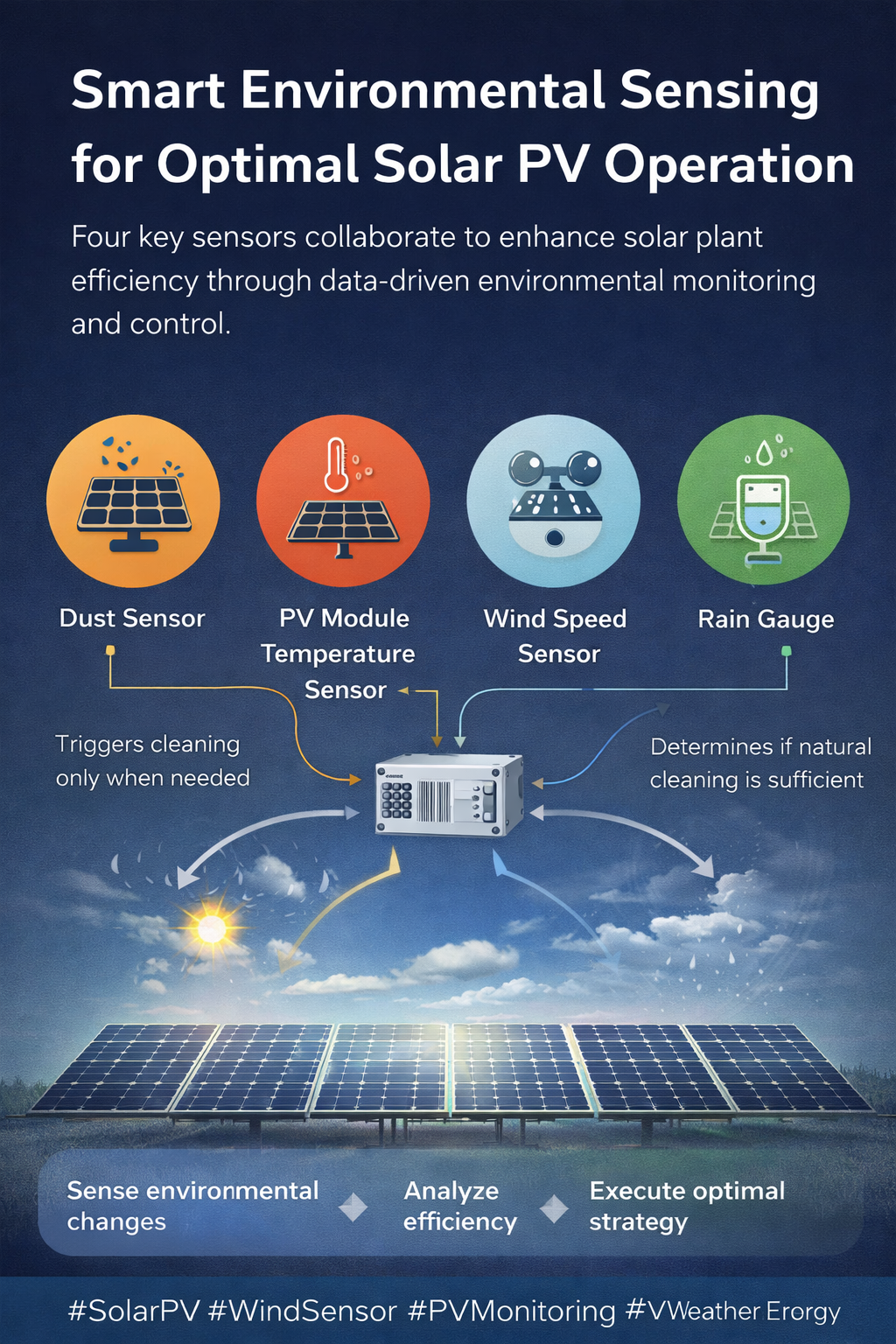
Modern solar installations increasingly rely on environmental sensors and weather stations to monitor conditions affecting performance.
Solar radiation sensors measure the actual amount of sunlight reaching the panels. This data helps:
Compare expected vs actual performance
Identify efficiency losses
Optimize system design
Monitoring ambient and panel temperature helps evaluate thermal losses and system efficiency.
Wind speed affects panel cooling. Higher wind speeds can reduce panel temperature and improve efficiency.
Comprehensive weather stations combine multiple sensors, including:
Solar radiation
Temperature and humidity
Wind speed and direction
Rainfall
These systems provide a complete picture of environmental conditions.
By combining environmental data with system performance data, operators can:
Detect anomalies in real time
Identify underperforming panels
Optimize cleaning schedules
Improve system design
Increase overall energy yield
This data-driven approach is essential for maximizing return on investment in solar projects.
While sunlight is essential, excessive heat can reduce efficiency.
Performance varies significantly depending on location, climate, and installation conditions.
Without monitoring, performance issues may go unnoticed for long periods.
As solar energy continues to expand, monitoring technologies are becoming more advanced.
Future trends include:
IoT-based monitoring systems
AI-powered performance analysis
Predictive maintenance
Cloud-based data platforms
These innovations will enable more efficient and reliable solar energy systems.
Solar panels are a powerful and sustainable energy solution, but their performance is influenced by many real-world factors. From solar radiation and temperature to dust, shading, and weather conditions, each variable plays a role in determining actual energy output.
Understanding these factors is essential for improving system efficiency and achieving expected performance.
By integrating environmental sensors and weather monitoring systems, solar operators can gain valuable insights, optimize performance, and ensure long-term reliability.
In the evolving energy landscape, data-driven monitoring is no longer optional—it is essential.
What are the uses of a rain gauge? Learn how rai
Learn how PAR sensors measure PPFD, optimize gro
Learn how soil EC sensors help optimize fertiliz
Contact: Molly
Phone: +86-17775769236
Tel: 86-0731-85117089
Email: molly@codasensor.com
Add: Building S5, Aux Square, Yuelu District, Changsha City, Hunan Province, China
We chat






 English


