Rainfall data has long been one of the most fundamental indicators in environmental monitoring, agriculture, and water resource management. From ancient rain gauges to modern automated weather stations, measuring precipitation has helped societies prepare for droughts, manage irrigation, and predict floods.
However, in today’s complex and data-driven world, relying solely on rainfall data is no longer sufficient. While precipitation provides valuable insight into how much water is entering a system, it does not reveal how that water behaves after it reaches the ground. Critical decisions—whether in farming, urban planning, or disaster management—require a more comprehensive understanding of environmental conditions.
This article explores why rainfall data alone falls short, what key factors are missing, and how integrated sensor systems provide a more complete and actionable picture.
Rainfall measurement answers a simple question: How much water fell from the sky? But it does not answer:
How much water was absorbed by the soil?
How much water evaporated?
How much contributed to runoff or flooding?
How much is actually available to plants?
Two regions receiving the same amount of rainfall can experience completely different outcomes. One may face flooding, while the other suffers from drought-like conditions shortly afterward.
A sandy soil area may absorb water quickly, leading to minimal runoff.
A clay-heavy region may retain water on the surface, increasing flood risk.
Without additional data, rainfall figures alone can be misleading and even dangerous when used for decision-making.
One of the most critical parameters missing from rainfall-only analysis is soil moisture.
Rainfall does not guarantee that crops receive the water they need. Soil conditions determine how much water is retained and available to plant roots.
Indicates real water availability for crops
Prevents over-irrigation and under-irrigation
Helps optimize fertilizer absorption
Improves yield prediction accuracy
Farmers relying only on rainfall data may irrigate unnecessarily after a storm, wasting water and energy. Conversely, they may skip irrigation when rainfall was insufficiently absorbed, stressing crops.
Integrating soil moisture sensors transforms raw rainfall data into actionable agricultural insights.
Rainfall data does not account for water loss due to evaporation, which can be significant—especially in hot and windy environments.
Temperature
Solar radiation
Wind speed
Humidity
High temperatures and strong sunlight can rapidly evaporate surface water, reducing effective moisture even after heavy rainfall.
A region may receive 20 mm of rain, but under intense sunlight and high temperatures, much of that water may evaporate within hours.
Without monitoring these environmental factors, rainfall data can create a false sense of water availability.
Not all rainfall stays where it falls. A significant portion may become surface runoff, especially in:
Urban areas with impermeable surfaces
Sloped terrain
Compacted or saturated soils
Increases flood risk
Reduces groundwater recharge
Causes soil erosion
Transports pollutants into water bodies
Cities often experience flash flooding even with moderate rainfall because drainage systems cannot handle rapid runoff.
Without monitoring water flow, water levels, and drainage conditions, rainfall data alone cannot predict or prevent such events.
Rainfall contributes to groundwater recharge, but this process is slow and influenced by many variables.
Monitoring groundwater levels provides insight into:
Long-term water availability
Aquifer health
Sustainability of water usage
A region may receive consistent rainfall but still face water shortages if groundwater is over-extracted or recharge rates are low.
Rainfall data does not reveal this hidden imbalance.
Not all rainfall events are equal. Two scenarios with the same total rainfall can have drastically different impacts:
Light rain over several days
High soil absorption
Minimal runoff
Heavy rain in a short period
Soil saturation
High runoff and flooding
Rainfall data alone often focuses on totals, but intensity and distribution over time are equally important.
High-resolution monitoring is necessary to capture these dynamics.
Different crops require different amounts of water at various growth stages.
Rice fields require continuous water presence
Grapevines prefer controlled water stress
Vegetables need consistent moisture levels
Rainfall data does not account for:
Crop type
Growth stage
Root depth
Soil-water interaction
Precision agriculture depends on combining rainfall with soil, climate, and crop data to make informed irrigation decisions.
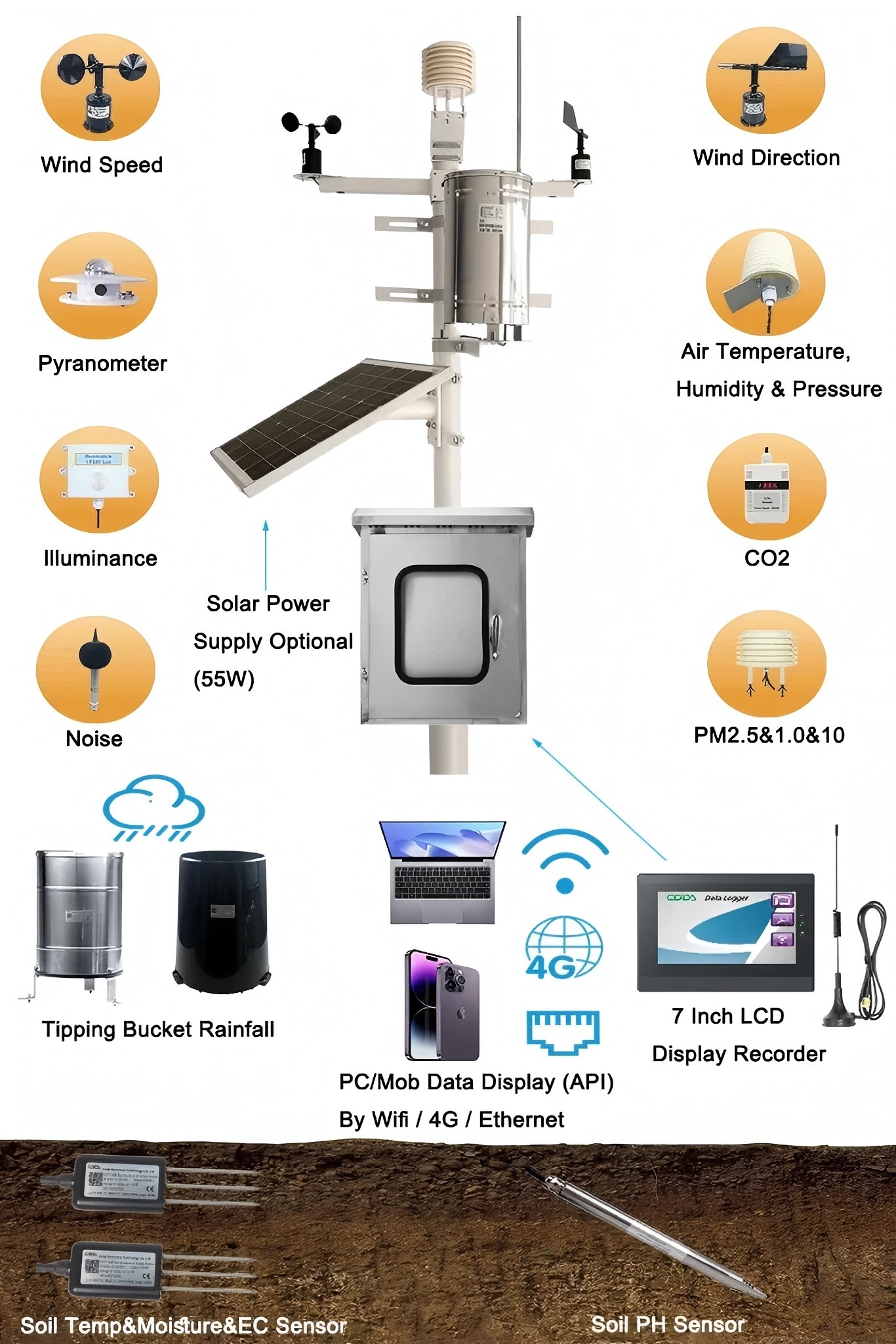
To overcome the limitations of rainfall-only data, modern monitoring systems integrate multiple sensors into a unified platform.
Rainfall (precipitation)
Air temperature and humidity
Wind speed and direction
Solar radiation
Water levels (rivers, reservoirs)
Real-time insights
Predictive analytics
Automated decision-making
Improved resource efficiency
In smart agriculture, a system may automatically trigger irrigation only when:
Soil moisture drops below a threshold
No significant rainfall is forecast
Evaporation rates are high
This level of precision is impossible with rainfall data alone.
Flood forecasting is one of the most critical applications of environmental monitoring.
While rainfall is a key input, accurate prediction requires:
Soil saturation levels
Drainage capacity
Terrain analysis
Weather forecasts
Flood disasters often occur not because rainfall was extreme, but because the system was already saturated or drainage was insufficient.
Integrated monitoring significantly improves early warning systems and reduces risk.
The future of environmental monitoring lies in data integration.
Modern platforms combine:
Sensor data
Satellite observations
Weather forecasts
AI-driven analytics
Smarter irrigation scheduling
Better disaster preparedness
Efficient water resource management
Reduced operational costs
Rainfall data becomes far more valuable when it is part of a larger ecosystem of information.
Rainfall data remains a vital component of environmental monitoring, but it is only one piece of a much larger puzzle. On its own, it cannot provide the depth of insight required for modern agriculture, urban planning, or disaster management.
To truly understand and manage water resources, it is essential to consider how rainfall interacts with soil, climate, terrain, and human activity. By integrating multiple data sources—such as soil moisture, temperature, evaporation, and water levels—organizations can move from reactive decisions to proactive, intelligent strategies.
In an era where precision and efficiency are critical, relying solely on rainfall data is no longer enough. The future belongs to comprehensive, sensor-driven monitoring systems that transform raw data into meaningful action.
What are the uses of a rain gauge? Learn how rai
Learn how PAR sensors measure PPFD, optimize gro
Learn how soil EC sensors help optimize fertiliz
Contact: Molly
Phone: +86-17775769236
Tel: 86-0731-85117089
Email: molly@codasensor.com
Add: Building S5, Aux Square, Yuelu District, Changsha City, Hunan Province, China
We chat






 English


