Modern agriculture is undergoing a significant transformation. Traditional farming methods, which rely heavily on experience and manual soil testing, are rapidly being replaced by data-driven precision agriculture systems.
At the core of this transformation is soil pH monitoring, a critical factor that directly influences soil fertility, nutrient availability, and crop productivity.
Soil pH determines whether essential nutrients such as nitrogen, phosphorus, and potassium are accessible to plants. Even in nutrient-rich soil, improper pH levels can block absorption and reduce crop yield significantly.
In smart agriculture, soil pH is no longer measured occasionally in laboratories. Instead, it is continuously monitored in real time using advanced IoT-based sensors, enabling farmers to make immediate, data-driven decisions.
Soil pH is a numerical scale that indicates the acidity or alkalinity of soil.
Acidic soil: pH below 7
Neutral soil: pH equals 7
Alkaline soil: pH above 7
Most agricultural crops perform best in a slightly acidic to neutral range, typically between 5.5 and 7.5.
Soil pH affects multiple biological and chemical processes in the soil:
Nutrient Availability
Soil pH controls the solubility of nutrients. In extreme acidic or alkaline conditions, essential nutrients become chemically unavailable.
Microbial Activity
Beneficial soil microorganisms responsible for organic matter decomposition thrive only within specific pH ranges.
Fertilizer Efficiency
Incorrect pH reduces fertilizer absorption efficiency, leading to waste and increased cost.
Root Development
Plant roots absorb water and nutrients more effectively in balanced pH conditions.
Soil Chemistry Stability
pH affects the chemical structure and long-term fertility of soil.
Without proper soil pH control, even advanced fertilization systems cannot achieve optimal results.
Before the adoption of smart agriculture systems, soil pH was measured using manual sampling and laboratory analysis.
Although accurate, this method has several major limitations:
Laboratory testing often requires days or weeks to deliver results, making it impossible for farmers to react quickly to changing soil conditions.
Soil conditions can change rapidly due to irrigation, rainfall, or fertilizer application. Manual testing cannot capture these dynamic changes effectively.
Collecting samples from large farms requires manpower, transportation, and laboratory fees.
A few soil samples cannot represent the variability of an entire agricultural field.
Farmers cannot use historical or real-time data to automate irrigation or fertilization.
These limitations highlight the need for continuous and automated soil monitoring systems.
Smart agriculture integrates sensors, communication networks, and cloud computing to create an intelligent farming ecosystem.
In this system, soil pH monitoring is combined with other environmental parameters such as:
Soil moisture
Soil temperature
Electrical conductivity (EC)
Weather conditions
Nutrient levels
Together, these parameters provide a complete understanding of soil health.
Real-time data collection
Remote monitoring via mobile or cloud platforms
Automated irrigation and fertilization
Predictive analytics using historical data
Integration with farm management systems
This shift enables agriculture to move from reactive practices to proactive optimization.
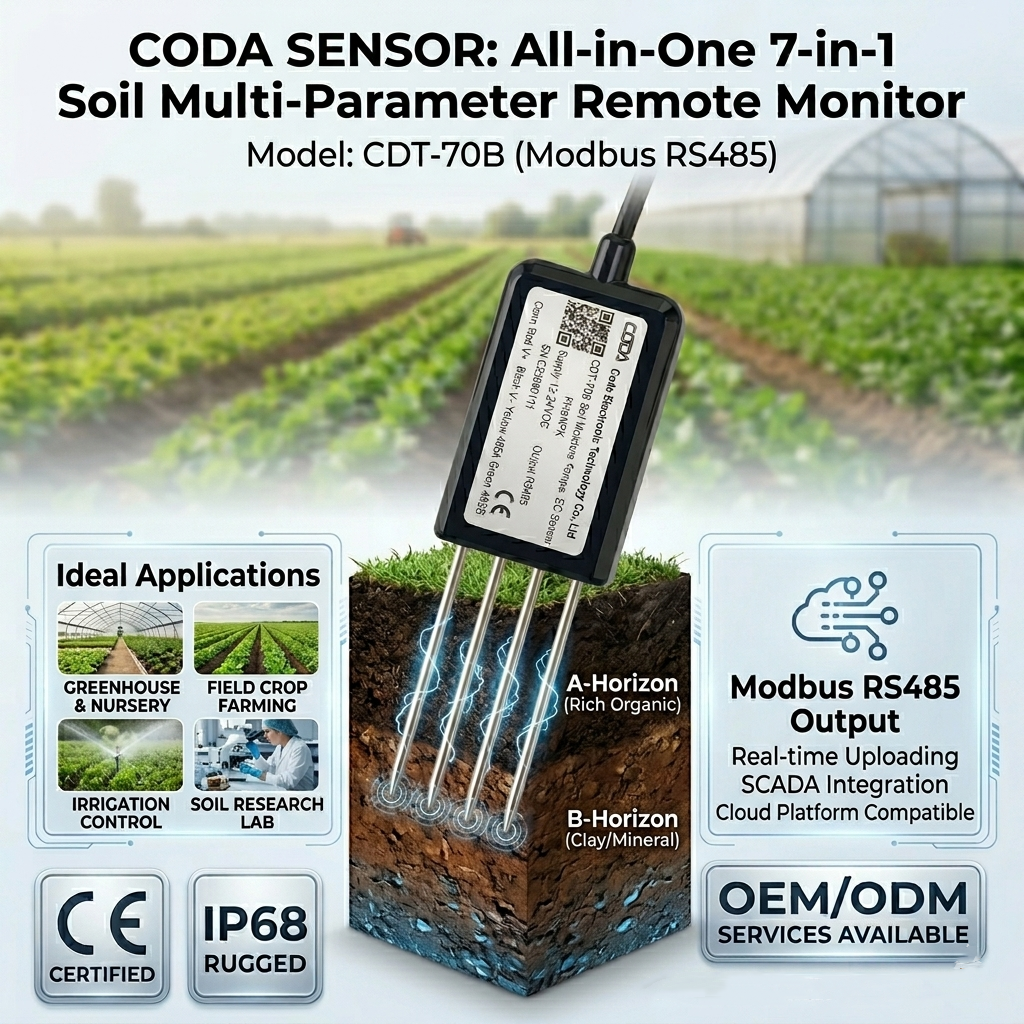
Modern soil pH sensors use electrochemical principles to measure hydrogen ion concentration in soil.
The sensor probe is inserted into the soil
The electrode interacts with soil moisture and ions
Hydrogen ion activity is detected
Electrical signals are generated
Signals are converted into digital output
Data is transmitted to a control system or cloud platform
Modern soil pH sensors often support:
RS485 communication
Modbus protocol
Analog output (0–5V / 4–20mA)
IoT wireless modules
High-quality agricultural sensors are designed with:
Waterproof housing
Corrosion-resistant electrodes
Temperature compensation
Long-term stability for field deployment
Low power consumption
These features ensure reliable operation in harsh agricultural environments.
The integration of real-time soil pH monitoring delivers significant agricultural advantages:
Balanced soil pH ensures optimal nutrient absorption, leading to healthier crops and increased productivity.
Precise pH data prevents over-fertilization and improves fertilizer efficiency.
Continuous monitoring helps prevent soil acidification and long-term degradation.
Soil pH influences water absorption, helping farmers optimize irrigation schedules.
Historical data enables predictive planning for crop rotation and soil improvement.
Efficient use of resources reduces operational costs and increases profitability.
Soil pH monitoring systems are widely used across multiple agricultural scenarios:
Used for precision fertilizer management and crop optimization across extensive fields.
Maintains controlled soil conditions for high-value crops.
Optimizes fruit quality by maintaining balanced soil chemistry.
Integrates soil data into automated irrigation control systems.
Used in soil science studies and experimental farming environments.
Supports land restoration and soil health tracking programs.
Soil pH sensors are not standalone devices. They are part of integrated IoT ecosystems.
A complete smart farming system typically includes:
Soil pH sensors
Soil moisture sensors
Weather stations
Cloud dashboards
Mobile applications
Automated irrigation controllers
Real-time monitoring from anywhere
Automated alerts for abnormal soil conditions
Fertilizer scheduling optimization
Data visualization and analytics
AI-based farming recommendations
This integration significantly enhances farming efficiency and decision-making accuracy.
Reliable sensor technology is the foundation of precision agriculture.
Coda Sensor develops advanced soil monitoring solutions designed for modern agriculture applications.
Their systems are engineered for:
Long-term field stability
High measurement accuracy
Multi-parameter soil monitoring
Seamless IoT integration
Harsh environmental conditions
These solutions support farmers, agribusinesses, and research institutions in achieving sustainable and data-driven agricultural production.
The future of soil pH monitoring is evolving rapidly with emerging technologies:
AI will analyze soil data and provide automated recommendations for fertilization and irrigation.
Soil pH data will directly control fertilizer injection and irrigation systems.
Combining satellite imaging with ground sensors for enhanced soil mapping.
Technologies like LoRa and NB-IoT will expand rural connectivity.
Entire farms will be digitally simulated for predictive optimization.
These innovations will redefine agricultural efficiency and sustainability.
Soil pH monitoring is no longer a supporting tool—it is a core component of modern smart agriculture.
By enabling real-time insights into soil conditions, farmers can optimize crop production, reduce waste, and improve long-term soil health.
With IoT-based soil pH sensors, agriculture is becoming:
More intelligent
More efficient
More sustainable
More profitable
As global food demand continues to rise, smart soil monitoring systems will play a critical role in ensuring food security and agricultural sustainability for the future.
What are the uses of a rain gauge? Learn how rai
Learn how PAR sensors measure PPFD, optimize gro
Learn how soil EC sensors help optimize fertiliz
Contact: Molly
Phone: +86-17775769236
Tel: 86-0731-85117089
Email: molly@codasensor.com
Add: Building S5, Aux Square, Yuelu District, Changsha City, Hunan Province, China
We chat






 English


