As industries continue to expand and environmental regulations become stricter, the need for reliable and real-time gas monitoring has never been more important. From industrial plants and underground tunnels to smart cities and agricultural greenhouses, air quality and gas safety directly impact human health, operational efficiency, and environmental sustainability.
A Multi Gas Sensor has emerged as a powerful and efficient solution for detecting multiple gases simultaneously in one integrated system. Instead of relying on multiple single-gas detectors, modern multi gas detection systems simplify installation, reduce cost, and provide more comprehensive environmental data in real time.
Today, multi gas monitoring technology is widely used in industrial safety systems, smart environmental monitoring platforms, agricultural automation, and IoT-based smart city projects.
A Multi Gas Sensor is an advanced gas detection device designed to measure and monitor multiple gas concentrations within a single unit. It integrates several sensing elements or modules into one compact system, enabling simultaneous detection of different gases in real time.
Compared to traditional single-gas sensors, a multi gas sensor offers:
Broader detection range
Higher system efficiency
Lower installation and maintenance costs
Centralized data monitoring
Depending on configuration and application, a multi gas sensor can detect a wide range of gases, including:
Carbon Dioxide (CO₂)
Carbon Monoxide (CO)
Oxygen (O₂)
Hydrogen Sulfide (H₂S)
Ammonia (NH₃)
Methane (CH₄)
Volatile Organic Compounds (VOC / TVOC)
Combustible gases
These capabilities make it an essential tool for both industrial safety and environmental monitoring systems.
Gas-related hazards are often invisible, odorless, and highly dangerous. Without proper monitoring, gas leaks or abnormal concentrations can lead to serious consequences such as explosions, equipment damage, environmental pollution, and health risks.
A multi gas monitoring system provides continuous real-time awareness of environmental conditions, enabling early detection and preventive action.
A single device can monitor multiple gases at the same time, reducing the need for multiple sensors and simplifying system design.
Continuous monitoring allows immediate detection of hazardous gas levels, enabling fast response before conditions become dangerous.
Multi gas detection systems help industries meet safety regulations and occupational health standards, especially in confined or high-risk environments.
By integrating multiple sensors into one system, users can significantly reduce equipment, installation, and maintenance costs.
Modern systems support IoT connectivity, enabling real-time data transmission via RS485, Modbus RTU, LoRa, 4G, or WiFi to cloud platforms for remote monitoring and analysis.
A multi gas sensor system typically combines different sensing technologies such as electrochemical sensors, infrared sensors (NDIR), and semiconductor sensors.
Each sensor element is responsible for detecting a specific gas type. The collected data is then processed by an internal microcontroller, which converts raw signals into readable gas concentration values.
The system then outputs data through communication interfaces such as:
RS485 / Modbus RTU (industrial automation systems)
4G / LTE (remote monitoring systems)
LoRa / LoRaWAN (low-power wireless networks)
WiFi / Ethernet (smart building integration)
This makes multi gas sensors highly adaptable across different industries and environments.
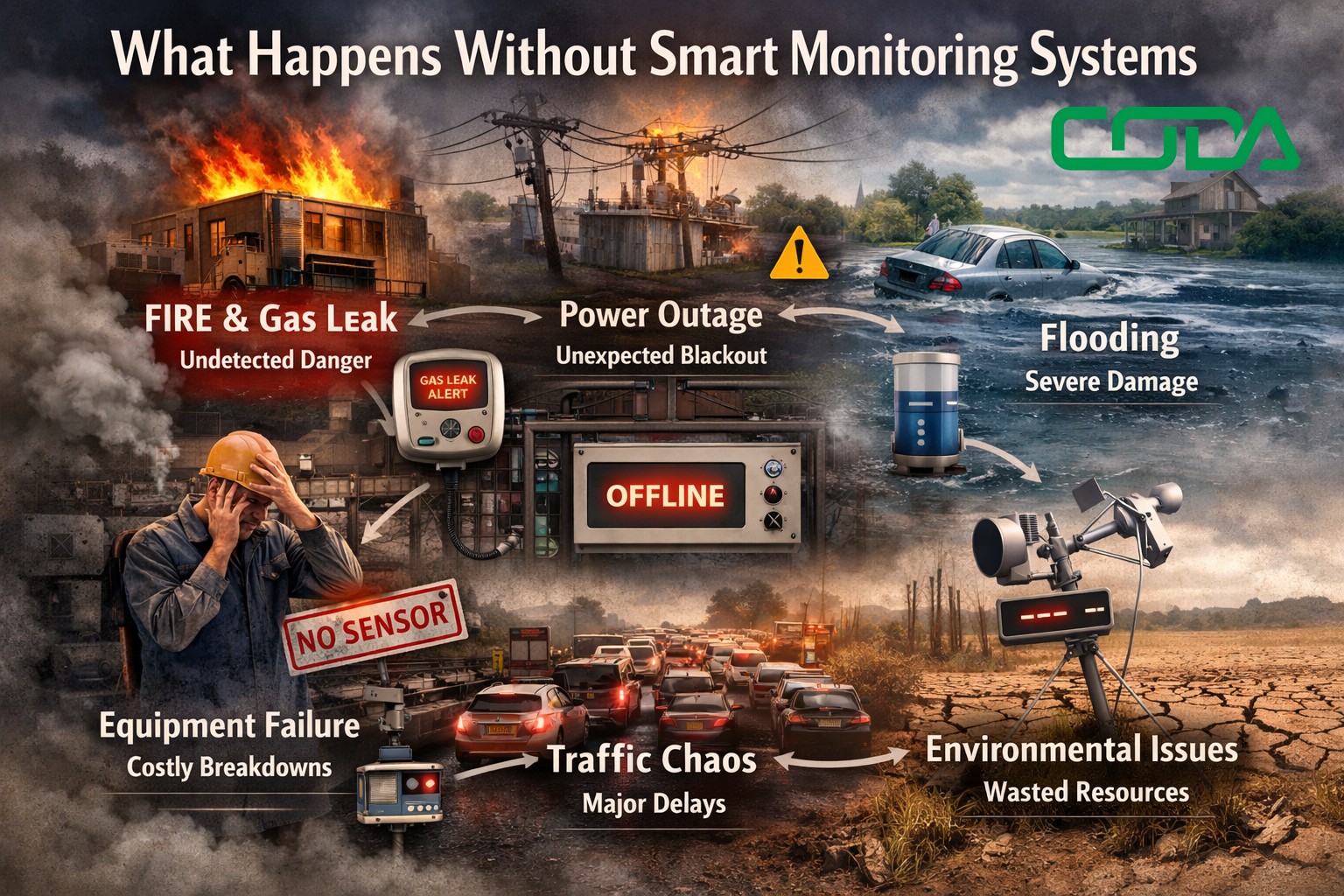
Industrial environments such as chemical plants, oil refineries, manufacturing facilities, and warehouses often contain hazardous gases.
Multi gas sensors are widely used to monitor:
Hydrogen sulfide (H₂S)
Methane (CH₄)
Oxygen (O₂) levels
These systems help prevent gas leaks, explosions, and toxic exposure, ensuring workplace safety and regulatory compliance.
As cities become more intelligent and data-driven, air quality monitoring plays a crucial role in public health and environmental management.
Multi gas sensors are deployed in:
Urban roadside monitoring stations
Industrial zones
Public parks and residential areas
Construction sites
They help track air pollution trends and support government decisions on environmental policies.
Modern agriculture increasingly relies on environmental monitoring to optimize crop growth conditions.
In greenhouses and livestock farms, multi gas sensors help monitor:
Ammonia (NH₃) in livestock environments
VOC levels affecting plant health
Temperature and humidity balance
By maintaining optimal air conditions, farmers can improve yield quality and reduce energy consumption.
Tunnels, mines, and underground facilities present high-risk environments due to limited ventilation and gas accumulation.
Multi gas detection systems are essential for monitoring:
Oxygen depletion
Toxic gas buildup
Combustible gas concentrations
These systems play a critical role in emergency prevention and worker protection.
Multi gas sensors are also used in environmental research stations to analyze atmospheric conditions, climate change patterns, and pollution levels over time.
Researchers use these systems to collect accurate long-term data for scientific studies and environmental forecasting.
When selecting a multi gas monitoring system, several important technical factors should be considered:
Reliable gas concentration measurement is essential for safety-critical applications.
Rapid detection ensures immediate alerts in case of hazardous gas leaks.
Support for RS485, Modbus RTU, 4G, LoRaWAN, and WiFi ensures seamless integration into different monitoring systems.
Outdoor installations require protection ratings such as IP65, IP66, or higher to withstand harsh environments.
Cloud-based platforms allow users to monitor real-time data from anywhere, improving efficiency and decision-making.
Energy-efficient design is especially important for remote or solar-powered installations.
Compared to traditional single-gas detection systems, multi gas sensors provide several advantages:
Reduced installation complexity
Lower maintenance requirements
More comprehensive environmental data
Improved monitoring efficiency
Better system scalability
This makes them ideal for modern IoT-based smart monitoring networks.
The development of IoT, AI, and smart environmental systems is driving rapid innovation in gas detection technology.
AI algorithms will help analyze gas data patterns and predict potential risks before they occur.
More systems will shift toward centralized cloud platforms for global remote monitoring and data management.
Low-power wireless communication technologies like LoRaWAN will enable large-scale environmental monitoring networks.
Future sensors will become smaller, more energy-efficient, and easier to deploy in remote areas.
Multi gas sensors will become a core component of smart city infrastructure, supporting environmental sustainability and public safety.
A Multi Gas Sensor is an essential tool in modern environmental monitoring and industrial safety systems. By enabling real-time detection of multiple gases within a single integrated device, it significantly improves safety, efficiency, and environmental awareness.
From industrial plants and underground tunnels to smart agriculture and urban air quality networks, multi gas sensors are playing a critical role in building safer, smarter, and more sustainable environments.
As IoT and smart monitoring technologies continue to evolve, multi gas detection systems will become even more intelligent, connected, and essential in global environmental management.
What are the uses of a rain gauge? Learn how rai
Learn how PAR sensors measure PPFD, optimize gro
Learn how soil EC sensors help optimize fertiliz
Contact: Molly
Phone: +86-17775769236
Tel: 86-0731-85117089
Email: molly@codasensor.com
Add: Building S5, Aux Square, Yuelu District, Changsha City, Hunan Province, China
We chat






 English


