Rainfall is one of the most important components of the Earth's water cycle. Measuring how much rain falls at a specific location helps us understand weather patterns, manage water resources, protect crops, and prepare for extreme weather events.
But what are the uses of a rain gauge, and why is rainfall measurement so important?
A rain gauge is a device designed to measure the amount of precipitation received over a specific period. Although the basic principle is simple, modern rain gauges are now widely used in sophisticated weather monitoring, smart agriculture, hydrology, flood warning, and environmental monitoring systems.
In this guide, we will explain what a rain gauge is, how it works, its major applications, the differences between manual and automatic rain gauges, and some frequently asked questions.
A rain gauge, also known as a rainfall gauge or pluviometer, is an instrument used to measure the amount of liquid precipitation that falls at a particular location.
Rainfall is normally measured in millimeters (mm).
For example, if a rain gauge records 25 mm of rainfall, this means that if the rainwater were evenly distributed over a flat surface, it would form a layer approximately 25 mm deep.
Rain gauges can range from simple manual collection containers to sophisticated automatic sensors connected to data loggers and cloud platforms.
Common types include:
Manual rain gauges
Weighing rain gauges
Optical rain gauges
Automatic rainfall monitoring systems
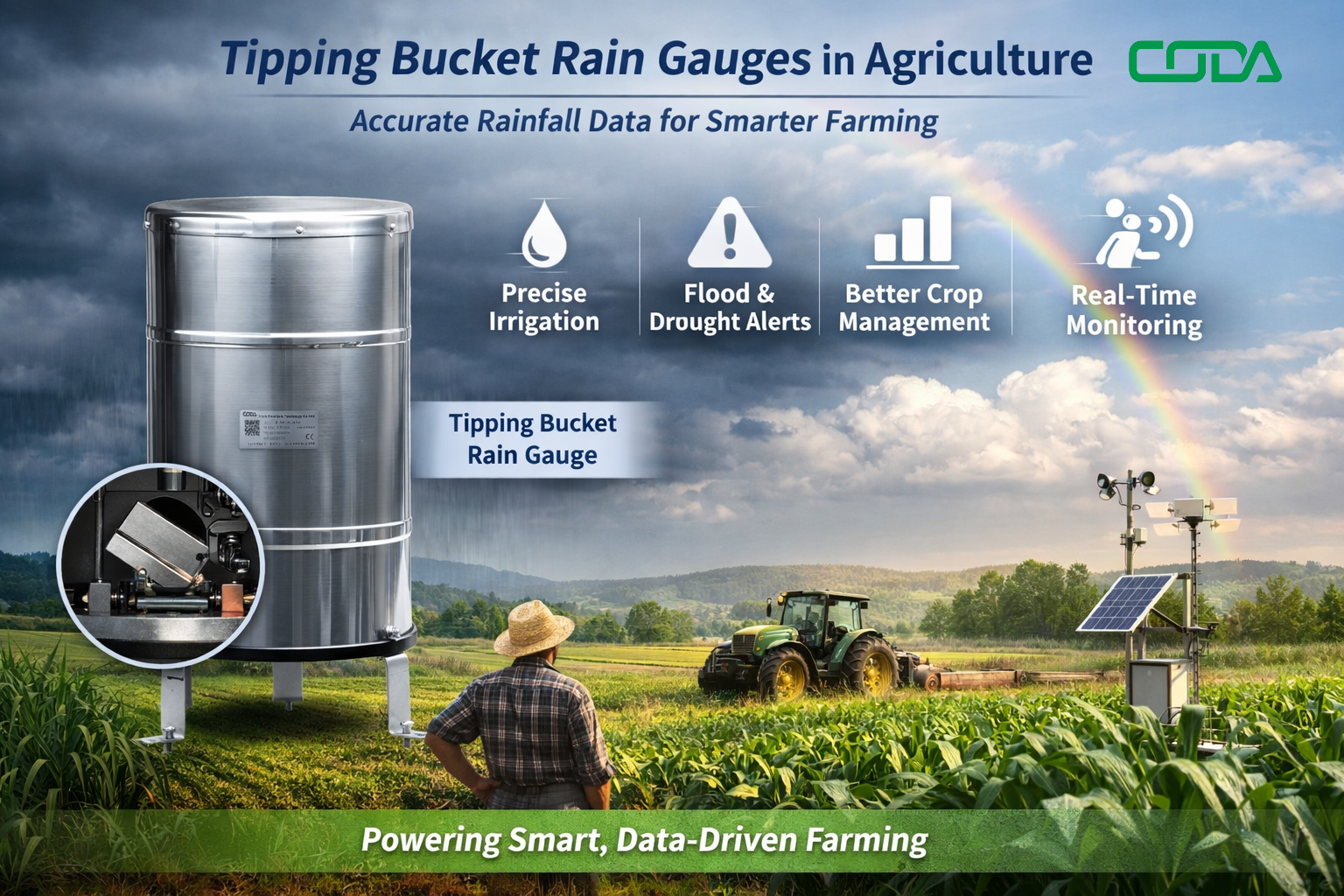
Among these, the tipping bucket rain gauge is particularly popular for automatic weather stations because it can continuously measure rainfall and generate digital output for remote monitoring.
The operating principle depends on the type of rain gauge.
A traditional manual rain gauge collects rainwater in a container. The collected water is then measured manually.
A tipping bucket rain gauge works differently.
When rain enters the collection funnel, it flows into a small calibrated tipping bucket. Once the bucket reaches a predefined volume, it tips and empties the collected water.
Each tipping event represents a specific amount of rainfall.
For example:
Rainfall → Funnel → Tipping Bucket → Sensor → Data Logger → Cloud Platform
The system can count the number of tipping events and calculate the total rainfall.
Because the measurement can be performed automatically, tipping bucket rain gauges are widely used in remote weather stations and IoT environmental monitoring systems.
Rain gauges have applications across many industries. Here are some of the most important ones.
One of the primary uses of a rain gauge is meteorological monitoring.
Weather stations collect rainfall data together with other parameters such as:
Temperature
Relative humidity
Wind speed
Wind direction
Atmospheric pressure
Solar radiation
Combining these measurements helps meteorologists understand local weather conditions and precipitation patterns.
Rainfall data can also contribute to weather forecasting and the analysis of extreme weather events.
Rainfall has a direct impact on agricultural production.
Farmers need to know how much natural rainfall their crops receive so they can determine whether additional irrigation is necessary.
A rain gauge can help farmers monitor:
Daily rainfall
Weekly rainfall
Cumulative precipitation
Rainfall intensity
Dry periods
Heavy rainfall events
For example, if a farm receives significant rainfall overnight, the irrigation schedule can be adjusted to avoid unnecessary water consumption.
When integrated with soil moisture sensors and weather stations, rainfall data becomes an important component of precision agriculture.
Efficient irrigation is becoming increasingly important as water resources become more limited.
Rainfall monitoring allows irrigation systems to respond to actual environmental conditions rather than relying only on fixed schedules.
A smart irrigation system can use:
Rainfall Data + Soil Moisture + Weather Forecast → Irrigation Decision
If sufficient rainfall has occurred, irrigation can be reduced.
If rainfall is low and soil moisture is declining, irrigation can be increased.
This approach can help improve water-use efficiency while maintaining suitable growing conditions for crops.
Heavy rainfall is a major contributor to flooding.
Real-time rainfall monitoring can provide valuable information for flood risk assessment and early warning systems.
Automatic rain gauges can continuously monitor precipitation and transmit data to a central platform.
If rainfall exceeds a predefined threshold, the system can generate an alert.
Rainfall monitoring can therefore be used in:
Flood warning systems
River basin monitoring
Urban flood monitoring
Stormwater management
Watershed monitoring
For more comprehensive flood monitoring, rainfall sensors can be combined with water level sensors.
Rainfall is an important input in hydrological studies.
Hydrologists use rainfall data to understand how precipitation affects:
Rivers
Lakes
Reservoirs
Groundwater
Surface runoff
Watersheds
Long-term rainfall records can help researchers estimate water availability and understand how rainfall patterns change over time.
This information is useful for reservoir management, water supply planning, and watershed management.
Rapid urbanization increases the importance of effective drainage systems.
Buildings, roads, parking areas, and other impermeable surfaces prevent rainwater from naturally infiltrating the soil.
As a result, heavy rainfall can quickly generate surface runoff.
Rain gauges can help city authorities monitor precipitation and evaluate stormwater conditions.
Rainfall data can support:
Drainage system planning
Stormwater management
Urban flood prevention
Drainage capacity analysis
Smart city monitoring
Multiple automatic rain gauges can also be deployed across different areas of a city to create a distributed rainfall monitoring network.
Long-term rainfall data is extremely valuable for climate research.
Researchers can analyze historical rainfall records to identify:
Seasonal rainfall patterns
Drought conditions
Extreme precipitation events
Changes in precipitation intensity
Long-term environmental trends
Rainfall data becomes even more useful when combined with temperature, humidity, wind, and solar radiation measurements.
Rainfall can significantly affect construction activities.
Heavy rain may cause delays, soil instability, excavation problems, and safety risks.
Construction companies can use rainfall monitoring to support:
Construction scheduling
Excavation planning
Site safety
Material protection
Project risk management
For large construction sites, automatic rain gauges can provide continuous rainfall records without requiring workers to manually measure precipitation.
Rain can affect road safety and transportation conditions.
Heavy precipitation may lead to:
Reduced visibility
Water accumulation
Slippery roads
Road flooding
Increased accident risks
Rain gauges can be incorporated into road weather information systems.
When combined with wind, visibility, temperature, and road surface sensors, rainfall monitoring can provide transportation authorities with a more complete understanding of road weather conditions.
Rain gauges are also commonly used in schools, universities, laboratories, and agricultural research centers.
Students and researchers can use rainfall measurements to study:
The water cycle
Local climate
Precipitation patterns
Rainfall intensity
Relationships between rainfall and plant growth
Because rainfall measurement is relatively easy to understand, rain gauges are useful for both educational and professional applications.
There are two general approaches to rainfall measurement: manual and automatic.
A manual rain gauge requires a person to collect and measure the rainfall.
Advantages:
Simple design
Easy to understand
Relatively low cost
Suitable for basic applications
Limitations:
Requires manual observation
Cannot easily provide real-time data
Difficult to use in remote locations
Higher labor requirements
An automatic rain gauge measures and records rainfall electronically.
It can be connected to a data logger and communication system for remote monitoring.
Advantages:
Automatic measurement
Real-time data collection
Reduced labor requirements
Suitable for remote locations
Easy integration with weather stations
Can support cloud-based monitoring
For modern environmental monitoring projects, automatic rain gauges are generally more suitable when continuous data is required.
Installing a rain gauge correctly is just as important as selecting the right sensor.
Several factors can affect rainfall measurement accuracy.
The rain gauge should be installed in an open area without nearby buildings, trees, or other obstacles that could block or redirect rainfall.
Strong wind can affect the amount of rain entering the collection funnel.
The rain gauge should be installed level so that the collection mechanism operates correctly.
Leaves, dust, insects, and other debris can block the funnel and affect measurements.
Regular inspection and cleaning are therefore important.
Calibration helps ensure that the rain gauge continues to provide reliable measurements over time.
The right rain gauge depends on the application.
Before selecting a rain gauge, consider:
Make sure the sensor can handle the expected rainfall conditions in your region.
Higher resolution can be important when monitoring light rainfall or short-duration precipitation events.
Consider the required measurement accuracy for your application.
Common interfaces include:
Pulse output
RS485
Modbus RTU
SDI-12
Analog output
For remote monitoring, the rain gauge can be connected to:
4G
Wi-Fi
LoRa
LoRaWAN
Ethernet
For outdoor applications, a suitable IP rating and durable housing are important.
A modern automatic rainfall monitoring system usually consists of several components.
Rain Gauge → Data Logger → Communication Module → Cloud Platform → User
The rain gauge measures precipitation.
The data logger receives and stores the measurements.
The communication module transmits the data through cellular, Wi-Fi, LoRa, or another communication technology.
Finally, the cloud platform allows users to view rainfall data remotely.
Users can monitor:
Current rainfall
Daily rainfall
Monthly rainfall
Cumulative rainfall
Historical data
Rainfall trends
Alarm events
This architecture makes automatic rainfall monitoring suitable for large-scale environmental monitoring networks.
The main purpose of a rain gauge is to measure the amount of precipitation that falls at a specific location over a particular period.
Rainfall is commonly measured in millimeters (mm). In some countries, rainfall may also be expressed in inches.
Rain gauges help farmers monitor natural rainfall and make better irrigation decisions. They can also support crop management, drought monitoring, and precision agriculture.
An automatic rain gauge is a sensor that measures rainfall electronically and can automatically transmit or record the collected data without requiring manual observation.
Yes. Rain gauges are widely used in flood monitoring and early-warning systems because rainfall intensity and accumulated rainfall can provide important information about potential flood risks.
For automatic systems, regular inspection and maintenance are recommended. The exact maintenance interval depends on the environment, rainfall conditions, and sensor design.
Yes. Many rain gauges can be integrated with automatic weather stations and data loggers to monitor rainfall together with temperature, humidity, wind, solar radiation, and other parameters.
Yes. With a suitable data logger and communication module, rainfall data can be transmitted through 4G, Wi-Fi, LoRa, LoRaWAN, or Ethernet to a remote monitoring platform.
A tipping bucket rain gauge is an automatic rainfall sensor that uses a calibrated bucket mechanism. When a specific amount of rainwater is collected, the bucket tips and generates a measurement signal.
Rainfall monitoring provides important information for agriculture, water management, flood prevention, weather research, infrastructure planning, and environmental monitoring.
Rain gauges may be simple instruments, but their applications are extensive.
From agriculture and irrigation to flood monitoring, hydrology, weather forecasting, smart cities, transportation, and climate research, accurate rainfall measurement provides valuable information for decision-making.
With the development of IoT technology, automatic rain gauges can now be integrated with data loggers, wireless communication systems, and cloud platforms to provide real-time rainfall monitoring from almost anywhere.
Whether you are developing a smart agriculture system, weather station, flood warning network, or environmental monitoring project, choosing a reliable rain gauge is an important first step toward obtaining accurate precipitation data.
Understanding rainfall is the first step toward managing water more intelligently.
What are the uses of a rain gauge? Learn how rai
Learn how PAR sensors measure PPFD, optimize gro
Learn how soil EC sensors help optimize fertiliz
Contact: Molly
Phone: +86-17775769236
Tel: 86-0731-85117089
Email: molly@codasensor.com
Add: Building S5, Aux Square, Yuelu District, Changsha City, Hunan Province, China
We chat

 English


