Fertilizer is one of the most significant inputs in modern agriculture, directly affecting crop yield, soil fertility, and farm profitability. However, its overuse or uneven application has become a widespread problem in many farming systems. Excess fertilizer not only increases production costs but also leads to nutrient leaching, soil degradation, and environmental pollution.
To address this challenge, precision agriculture technologies are increasingly being adopted. Among them, soil EC (Electrical Conductivity) sensors play a critical role in understanding soil fertility variability and optimizing fertilizer application.
Soil EC sensors provide a fast, reliable, and non-destructive way to assess soil conditions. By measuring the soil’s ability to conduct electrical current, they help infer key properties such as salinity, nutrient availability, moisture distribution, and soil texture variability. When integrated into smart farming systems, EC sensors become powerful tools for data-driven fertilizer management.
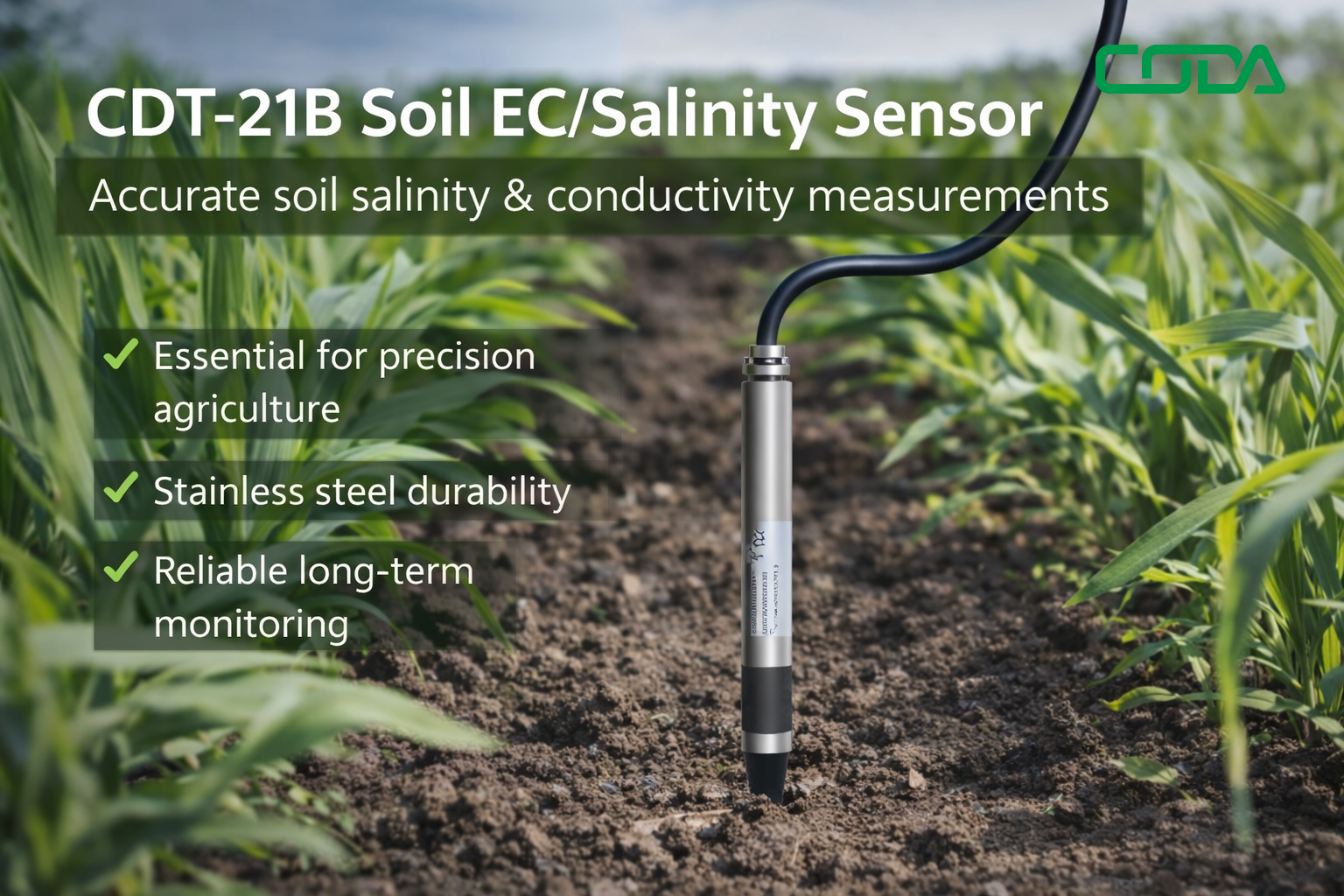
Soil electrical conductivity refers to the ability of soil to conduct an electric current. It is influenced by:
Soil moisture content
Salt concentration (salinity)
Clay and organic matter content
Temperature
Fertilizer ions (nitrate, potassium, ammonium)
Higher EC generally indicates higher ionic activity in the soil, which often correlates with higher fertility or higher salinity depending on conditions.
EC mapping reveals differences in soil properties across a field, allowing farmers to avoid uniform fertilizer application.
Fertilizer is adjusted according to EC zones:
High EC → reduce fertilizer
Low EC → increase fertilizer
Medium EC → standard application
Precision application reduces fertilizer waste by 10–30% in many cases.
Balanced nutrient distribution improves crop uniformity and productivity.
Reduces nutrient leaching and water pollution.
A 500-hectare corn farm in the Midwest USA had been facing rising fertilizer costs and inconsistent yield patterns. Despite applying uniform nitrogen fertilizer across the field, some zones produced significantly lower yields.
Soil testing showed that the field had strong spatial variability in:
Soil texture (clay vs sandy zones)
Moisture retention
Nutrient holding capacity
Traditional sampling was too limited to capture full variability.
The farm introduced soil EC sensors mounted on a mobile mapping system to scan the entire field. The EC map revealed:
High EC zones (clay-rich, nutrient-retentive areas)
Low EC zones (sandy, fast-draining areas)
These zones were converted into prescription maps for fertilizer application.
Using Variable Rate Application (VRA):
Low EC zones received 20–25% more nitrogen fertilizer
High EC zones received 15% less fertilizer
Medium zones remained unchanged
After one growing season:
Fertilizer usage reduced by 18%
Average yield increased by 12%
Yield variability across the field significantly reduced
Nitrogen leaching risk decreased
Soil EC mapping allowed the farmer to treat the field as multiple management zones instead of one uniform area.
A 120-hectare citrus orchard in southern Spain was experiencing uneven tree growth. Some areas showed yellowing leaves and reduced fruit size.
The orchard was irrigated using groundwater with moderate salinity. Over time:
Salt accumulation increased in some zones
Fertilizer efficiency decreased in high-salinity areas
Tree stress became uneven across the orchard
Soil EC sensors were installed at multiple depths across representative orchard zones. Data was transmitted to a cloud platform for monitoring.
High EC zones correlated with salt accumulation
Low EC zones indicated nutrient depletion
Irrigation patterns were uneven due to slope differences
Adjusted irrigation scheduling to reduce salt buildup
Reduced fertilizer application in high EC zones
Increased organic amendments in affected areas
Installed improved drainage in salt-affected zones
After two seasons:
Tree health became more uniform
Fruit size consistency improved by 20%
Fertilizer efficiency improved significantly
Soil salinity levels stabilized
In perennial systems like orchards, EC sensors are not only fertilizer tools but also long-term soil health monitoring instruments.
Soil EC sensors become more powerful when integrated with:
IoT data loggers (4G / LoRa / WiFi)
Cloud platforms for real-time visualization
GPS-based mapping systems
Automated irrigation and fertilization systems
This enables farmers to shift from reactive farming to predictive and data-driven agriculture.
No. EC measures soil electrical conductivity, not nutrients directly. However, it correlates with nutrient levels, moisture, and salinity, making it a useful indirect indicator.
No. EC sensors complement traditional soil testing but do not replace it. Lab tests are still needed for precise nutrient composition analysis.
For precision farming, EC data is typically collected:
Seasonally for mapping
Weekly or daily in high-tech farms using fixed sensors
Yes, but interpretation varies:
Clay soils naturally show higher EC
Sandy soils show lower EC
Calibration is important for accurate interpretation.
Indirectly yes. Sudden increases in EC may indicate excessive salt or fertilizer accumulation, especially after application.
EC sensors measure ionic activity and salinity
Moisture sensors measure water content
Together, they provide a more complete soil profile.
Yes. Even small farms benefit from EC data, especially when optimizing fertilizer use in high-value crops.
High-quality industrial EC sensors typically last several years, depending on soil conditions, installation quality, and maintenance.
Soil EC sensors have become a core technology in precision agriculture. By revealing soil variability, guiding fertilizer application, and supporting long-term soil monitoring, they significantly improve both economic and environmental outcomes.
With real-world applications showing fertilizer reductions of up to 30% and yield improvements exceeding 10%, EC-based farming is no longer a future concept—it is already a practical solution for modern agriculture.
As digital farming continues to evolve, EC sensors will remain a key bridge between soil variability and intelligent fertilizer management.
What are the uses of a rain gauge? Learn how rai
Learn how PAR sensors measure PPFD, optimize gro
Learn how soil EC sensors help optimize fertiliz
Contact: Molly
Phone: +86-17775769236
Tel: 86-0731-85117089
Email: molly@codasensor.com
Add: Building S5, Aux Square, Yuelu District, Changsha City, Hunan Province, China
We chat






 English


