As global demand for renewable energy continues to grow, solar photovoltaic (PV) power plants are being deployed at an unprecedented scale. From distributed rooftop systems to multi-megawatt solar farms, maximizing efficiency and ensuring long-term structural safety have become top priorities for investors and operators.
While solar radiation is the most obvious performance factor, wind speed is a critical yet often underestimated parameter in PV system optimization. Wind affects panel temperature, mechanical stress, structural stability, and even cleaning efficiency.
This is where a high-precision wind sensor for solar power plant applications, such as the CDF-21A Ultrasonic Wind Speed & Direction Sensor, plays a vital role. By integrating accurate wind data into a comprehensive PV weather monitoring strategy, operators can improve performance, enhance safety, and reduce operational risks.
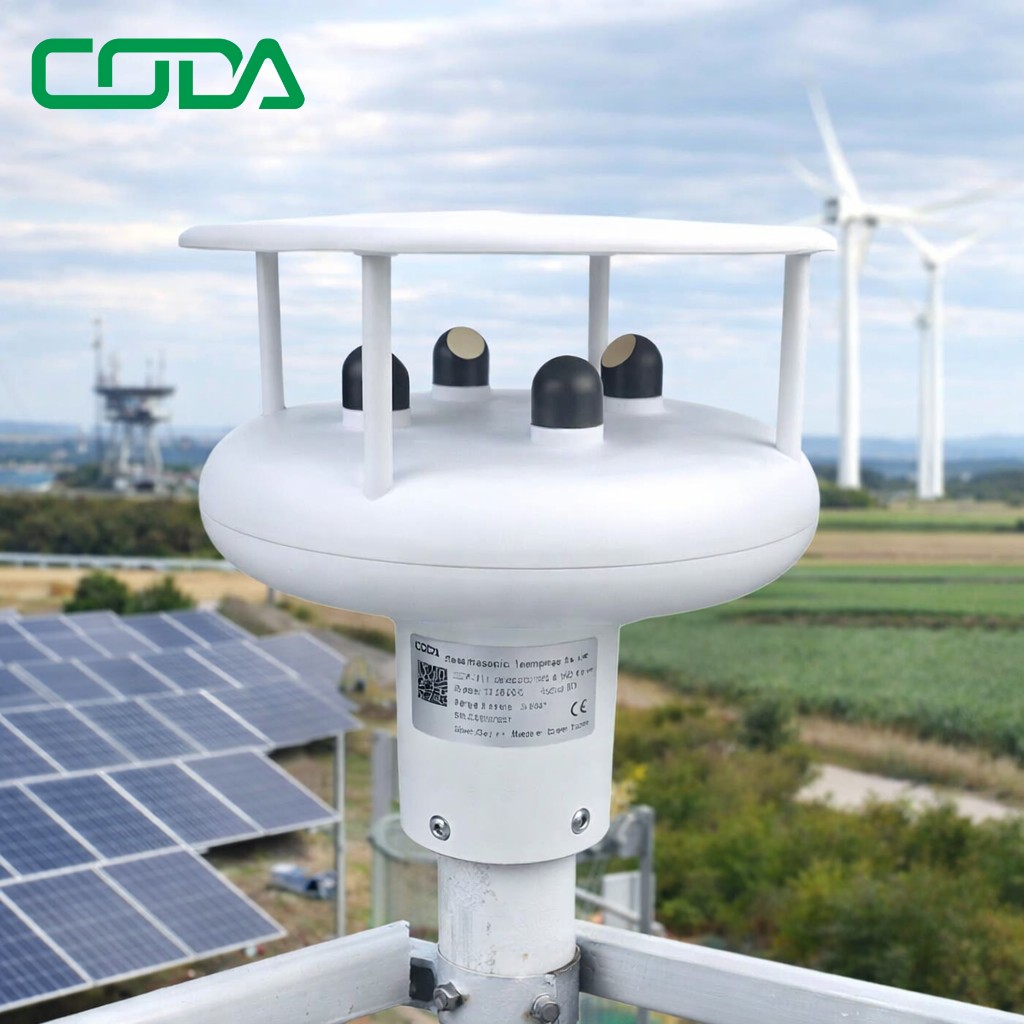
Wind interacts with solar installations in multiple ways:
Thermal Regulation
Structural Load Management
Tracker Protection
Dust and Soiling Impact
Predictive Maintenance
Understanding these interactions is essential for optimizing plant performance.
Solar panels convert sunlight into electricity, but they also generate heat. As panel temperature rises, efficiency decreases. In fact, most PV modules lose approximately 0.3% to 0.5% of output for every 1°C increase above standard test conditions.
Wind acts as a natural cooling mechanism:
Increased airflow removes excess heat from module surfaces
Reduced operating temperature improves electrical efficiency
Enhanced thermal stability extends panel lifespan
Without accurate wind measurement, operators cannot precisely model real-world performance deviations.
By deploying an ultrasonic wind sensor as part of a wind monitoring system, plant managers can:
Correlate wind speed with panel temperature data
Improve performance ratio calculations
Refine energy yield forecasting models
This data-driven approach leads to more accurate energy production predictions and improved ROI.
Large-scale solar farms cover vast open areas, making them highly exposed to wind forces. Elevated mounting structures and tracker systems are particularly vulnerable to strong gusts.
Structural fatigue
Mounting frame deformation
Tracker misalignment
Extreme case: panel detachment
Real-time wind data from a professional wind sensor for solar power plant installations enables immediate response mechanisms.
When integrated into plant control systems, wind sensors can:
Trigger automatic stow positions for trackers
Adjust tilt angles to minimize wind resistance
Issue safety alerts to operators
Shut down sensitive components when thresholds are exceeded
Ultrasonic wind sensors provide fast response times, ensuring protection even during sudden gust events.
Modern utility-scale solar plants frequently use single-axis or dual-axis tracking systems to maximize sunlight exposure. While trackers increase energy yield by up to 20–30%, they introduce mechanical complexity and higher vulnerability to wind damage.
Tracking systems are dynamic structures. Under high wind conditions, improper positioning can amplify stress on actuators and support frames.
An integrated PV weather monitoring system allows:
Continuous wind speed measurement
Predefined safety threshold activation
Automated transition to horizontal “stow” position
Reduced mechanical strain during storms
Ultrasonic wind sensors offer significant advantages over mechanical cup anemometers:
No moving parts
Higher durability
Minimal maintenance
Faster data sampling
Greater accuracy in turbulent airflow
This ensures reliable operation in harsh outdoor solar farm environments.
Wind monitoring contributes directly to predictive maintenance strategies.
By analyzing wind data trends, operators can identify:
Structural resonance issues
Abnormal vibration under specific wind conditions
Tracker response delays
Mounting instability
Over time, combining wind data with structural sensor data improves risk modeling and reduces unexpected failures.
Unplanned downtime significantly affects plant profitability. Accurate wind monitoring supports:
Storm preparation
Maintenance scheduling based on environmental stress
Insurance documentation for extreme weather events
A reliable wind monitoring system becomes a key component of risk mitigation planning.
Data integration is essential in modern renewable energy management.
A professional wind sensor for solar power plant installations must support industrial communication protocols such as:
RS485
Modbus
TCP/IP integration
SCADA compatibility
The CDF-21A Ultrasonic Wind Sensor enables seamless integration into plant supervisory control and data acquisition (SCADA) systems.
Centralized real-time monitoring
Historical data logging
Remote diagnostics
Automated alarm triggers
Data visualization dashboards
When wind speed data is combined with irradiance, temperature, and power output data, operators gain a complete operational overview.
Accurate production forecasting is critical for:
Grid stability
Power purchase agreements (PPA)
Revenue estimation
Energy trading
Wind speed directly influences module temperature and therefore output efficiency. By integrating wind data into forecasting algorithms, plants achieve:
More accurate day-ahead predictions
Improved seasonal modeling
Reduced deviation penalties
This strengthens financial performance and grid compliance.
Compared to traditional mechanical wind measurement devices, ultrasonic sensors offer superior performance for solar farm deployment.
1. No Moving Parts
Eliminates mechanical wear and maintenance costs.
2. High Accuracy
Precise wind speed and direction measurement.
3. Fast Response Time
Critical for sudden gust protection.
4. Low Maintenance Requirements
Ideal for remote, large-scale installations.
5. Long-Term Stability
Reliable performance in extreme weather conditions.
6. IP66 Weather Protection
Resistant to dust, rain, snow, and harsh outdoor environments.
For solar plants located in desert, coastal, or mountainous regions, durability and stability are non-negotiable.
Financial institutions increasingly require detailed environmental monitoring for project bankability.
Wind monitoring contributes to:
Structural compliance documentation
Environmental reporting
Insurance claims validation
Performance guarantee verification
A well-designed PV weather monitoring system enhances transparency and investor confidence.
As hybrid solar-wind energy plants become more common, accurate wind measurement serves dual purposes:
Solar performance optimization
Wind turbine site assessment
This maximizes infrastructure value and enables flexible renewable deployment strategies.
The future of renewable energy lies in automation and intelligent systems.
By integrating ultrasonic wind sensors into IoT-enabled platforms, operators can achieve:
AI-driven performance optimization
Automated decision-making
Cloud-based monitoring
Real-time mobile alerts
Advanced environmental analytics
Wind data is no longer a secondary parameter—it is becoming a core variable in smart energy ecosystems.
Wind speed plays a far more significant role in solar PV plant performance than many operators realize. From panel cooling and energy efficiency to structural safety and tracker protection, accurate wind measurement directly impacts both profitability and long-term asset security.
By deploying a high-precision ultrasonic wind sensor for solar power plant applications, operators can:
Optimize PV performance
Protect tracking systems
Reduce maintenance risks
Improve forecasting accuracy
Enhance SCADA integration
Strengthen project bankability
A reliable wind monitoring system is not just an accessory—it is an essential component of modern PV weather monitoring strategies.
As solar power plants continue to expand globally, integrating advanced ultrasonic wind sensing technology will remain a key factor in maximizing efficiency, ensuring safety, and achieving sustainable energy growth.
What are the uses of a rain gauge? Learn how rai
Learn how PAR sensors measure PPFD, optimize gro
Learn how soil EC sensors help optimize fertiliz
Contact: Molly
Phone: +86-17775769236
Tel: 86-0731-85117089
Email: molly@codasensor.com
Add: Building S5, Aux Square, Yuelu District, Changsha City, Hunan Province, China
We chat






 English


