Accurate snow measurement plays a critical role in modern meteorology, hydrology, transportation safety, and infrastructure protection. As extreme weather events become more frequent and winter conditions grow increasingly unpredictable, reliable snow monitoring is no longer optional—it is essential.
Among today’s advanced technologies, the ultrasonic snow depth sensor has become a key component of any professional snow depth monitoring system. Compared with traditional manual measurement methods, ultrasonic technology offers higher accuracy, automation, real-time data access, and significantly reduced labor costs.
Snow depth data is used in multiple sectors:
Meteorological stations for winter climate analysis
Hydrology departments for snowpack and runoff forecasting
Transportation authorities for road safety management
Ski resorts for operational planning
Infrastructure monitoring for structural load protection
Inaccurate or delayed snow measurements can lead to poor decision-making, increased risks, and financial losses. That is why modern weather stations increasingly rely on automated sensing technologies.
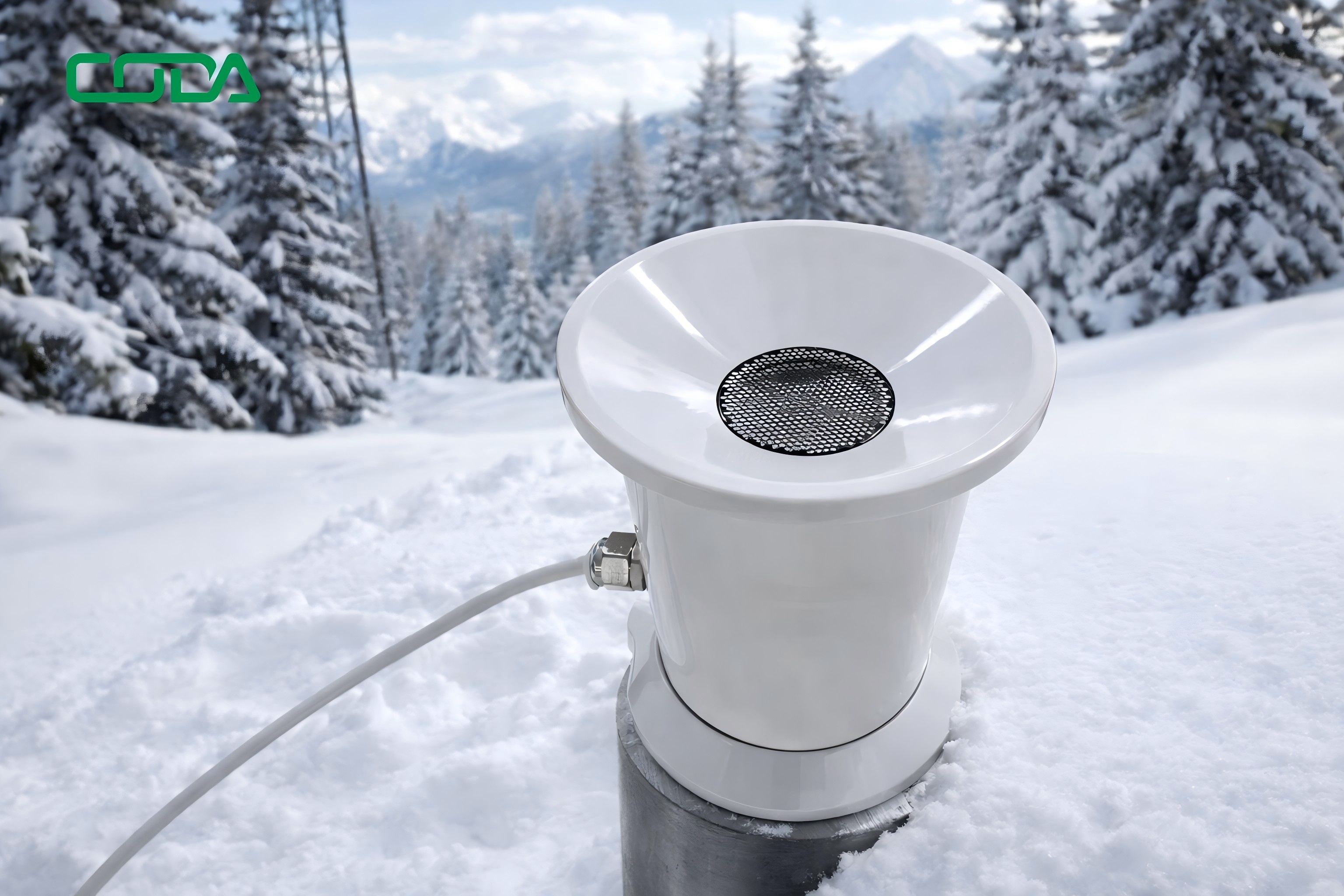
An ultrasonic snow depth sensor uses sound wave technology to measure the distance between the sensor and the snow surface.
Here’s how it works:
The sensor emits a high-frequency ultrasonic pulse downward.
The sound wave reflects off the snow surface.
The sensor measures the time it takes for the echo to return.
Using the speed of sound, the system calculates the distance.
Snow depth is determined by comparing the measured distance with the original installation height.
Because the measurement is completely non-contact, the sensor does not physically touch the snow. This eliminates mechanical wear and ensures long-term stability.
Before automated sensors became widely available, snow depth was typically measured using manual snow stakes or rulers. While simple, this method presents several challenges:
Field personnel must travel to remote or hazardous areas to perform measurements, especially during severe weather.
Manual readings are usually taken once or twice per day, limiting data resolution.
Measurement accuracy depends on the operator’s consistency and visibility conditions.
Winter storms, icy roads, and avalanche-prone areas pose serious risks to staff.
Manual recording may lack continuous digital storage for long-term trend analysis.
As weather monitoring systems evolved, these limitations made manual methods insufficient for modern requirements.
Unlike mechanical or probe-based systems, an ultrasonic sensor does not touch the snow surface. This prevents:
Physical damage
Snow compaction errors
Sensor blockage
The non-contact design ensures consistent performance even during heavy snowfall.
Modern weather station snow sensors provide:
Precise distance measurement
Stable readings in low temperatures
Minimal drift over time
With proper temperature compensation, ultrasonic sensors maintain reliable performance even in extreme winter environments.
A complete snow depth monitoring system allows continuous data collection and transmission. Instead of one daily reading, users receive:
24/7 real-time snow depth data
Configurable measurement intervals
Instant updates during snowstorms
This real-time capability supports faster and more informed decision-making.
Automation significantly lowers operational expenses by:
Eliminating routine manual measurements
Reducing travel to remote sites
Minimizing staffing requirements
Over time, the return on investment becomes clear, especially for large-scale monitoring networks.
Ultrasonic snow sensors can be integrated into:
Data loggers
IoT platforms
Cloud-based monitoring systems
With RS485, Modbus, or other communication protocols, users can monitor multiple stations remotely from a central control room.
A professional weather station snow sensor is essential for winter data collection. When combined with temperature, humidity, wind, and precipitation sensors, it provides a complete environmental profile.
Snow depth data supports snowpack analysis and runoff modeling, helping predict spring flooding and manage reservoirs.
Transportation agencies use real-time snow data to:
Schedule snowplows
Apply de-icing materials efficiently
Issue road safety alerts
Snow accumulation monitoring helps prevent structural overload on:
Bridges
Roofs
Communication towers
Solar panel systems
Climate variability and extreme weather events require higher data accuracy and faster response times. Manual systems simply cannot keep up with the demand for:
Continuous measurement
Digital storage
Real-time alerts
Remote access
Data analytics integration
Ultrasonic snow depth sensors meet all these requirements, making them indispensable in modern environmental monitoring networks.
As smart cities and IoT-based environmental systems expand, snow monitoring is becoming part of a larger connected ecosystem. Advanced sensors now support:
Cloud-based dashboards
Historical trend analysis
Alarm thresholds
AI-driven forecasting models
In this context, the ultrasonic snow depth sensor is no longer just a measurement tool—it is a critical data source in intelligent weather infrastructure.
Accurate snow depth measurement is vital for weather forecasting, hydrology, transportation safety, and infrastructure protection. While traditional manual methods served their purpose in the past, they no longer meet the demands of modern monitoring systems.
With non-contact measurement, high precision, automation, real-time data transmission, and reduced labor costs, the ultrasonic snow depth sensor has become an essential component of any advanced snow depth monitoring system and professional weather station snow sensor setup.
As environmental monitoring continues to evolve, ultrasonic technology stands at the forefront of reliable and intelligent winter data collection.
What are the uses of a rain gauge? Learn how rai
Learn how PAR sensors measure PPFD, optimize gro
Learn how soil EC sensors help optimize fertiliz
Contact: Molly
Phone: +86-17775769236
Tel: 86-0731-85117089
Email: molly@codasensor.com
Add: Building S5, Aux Square, Yuelu District, Changsha City, Hunan Province, China
We chat






 English


