As global temperatures continue to rise, heat stress has become a serious concern across many industries. Workers in construction, agriculture, manufacturing, mining, and solar energy facilities are frequently exposed to high temperatures and strong sunlight. Without proper monitoring, excessive heat can lead to fatigue, dehydration, reduced productivity, and even life-threatening heat stroke.
Most monitoring systems still rely only on air temperature. However, air temperature alone does not represent the true heat people feel. Solar radiation, hot surfaces, machinery, and airflow all influence thermal exposure.
To understand real environmental heat conditions, a more comprehensive measurement method is required. This is where a black globe temperature sensor plays an essential role.
A black globe temperature sensor is a professional instrument designed to measure the combined effects of radiant heat, air temperature, and convection.
The sensor features a matte black spherical globe that absorbs heat from all directions. Inside the globe, a high-precision temperature element records the accumulated thermal energy. Because the black surface efficiently absorbs radiation, the measured value reflects the total environmental heat load rather than just the surrounding air.
This measurement is known as globe temperature.
Unlike standard temperature probes, globe temperature more closely represents the actual thermal stress experienced by humans, animals, and equipment.
In simple terms, air temperature tells you how hot the air is, while globe temperature tells you how hot it really feels.
Traditional air temperature sensors measure shaded ambient air only. They do not account for many important heat sources such as:
Direct sunlight
Reflected heat from concrete or metal surfaces
Infrared radiation from machinery
Heat accumulation in enclosed spaces
Wind and convection effects
Because of these limitations, air temperature often underestimates real working conditions.
For example, the air temperature might read 30°C, but under strong sunlight or near hot equipment, the perceived heat could exceed 40°C or higher. This difference can significantly increase the risk of heat stress.
Relying solely on air temperature may lead to incorrect safety decisions and inadequate protection measures. A black globe temperature sensor provides a more accurate and reliable solution.
The working principle is simple but effective.
First, the black globe absorbs radiation from sunlight, ground surfaces, and nearby objects. Next, heat is transferred to the internal temperature sensor through radiation, conduction, and convection. Finally, the stabilized temperature is recorded as globe temperature.
Because the globe collects heat from all directions, it simulates how the human body absorbs environmental heat. This makes the measurement highly relevant for safety and comfort assessments.
Globe temperature provides a realistic view of environmental heat exposure. It helps safety managers understand actual risk levels instead of relying on incomplete data.
WBGT, or Wet Bulb Globe Temperature, is the international standard for evaluating heat stress. It is widely used in occupational safety guidelines and industrial regulations.
WBGT calculations require three parameters:
Dry bulb temperature
Wet bulb temperature
Globe temperature
Without globe temperature, WBGT cannot be calculated correctly. Therefore, a black globe temperature sensor is necessary for compliance with many safety standards.
With accurate data, organizations can implement preventive measures such as:
Adjusting work schedules
Increasing rest periods
Providing hydration
Activating alarms
Improving ventilation or shading
These actions reduce health risks and improve overall productivity.
The CDW-11A Black Globe Temperature Sensor from Coda Sensor is designed for professional environmental and industrial monitoring applications. It provides reliable globe temperature measurement with high accuracy and long-term stability.
The sensor is engineered to operate in demanding outdoor and industrial conditions while maintaining consistent performance. It can be easily integrated into weather stations, safety systems, and IoT monitoring platforms.
High precision and stable measurement
Fast response to environmental changes
Durable black globe for efficient radiation absorption
IP65 protection for outdoor use
Wide operating temperature range
RS485 Modbus output for digital communication
4–20 mA analog output for industrial control systems
Low power consumption and minimal maintenance
These features make the CDW-11A suitable for both small projects and large-scale monitoring networks.
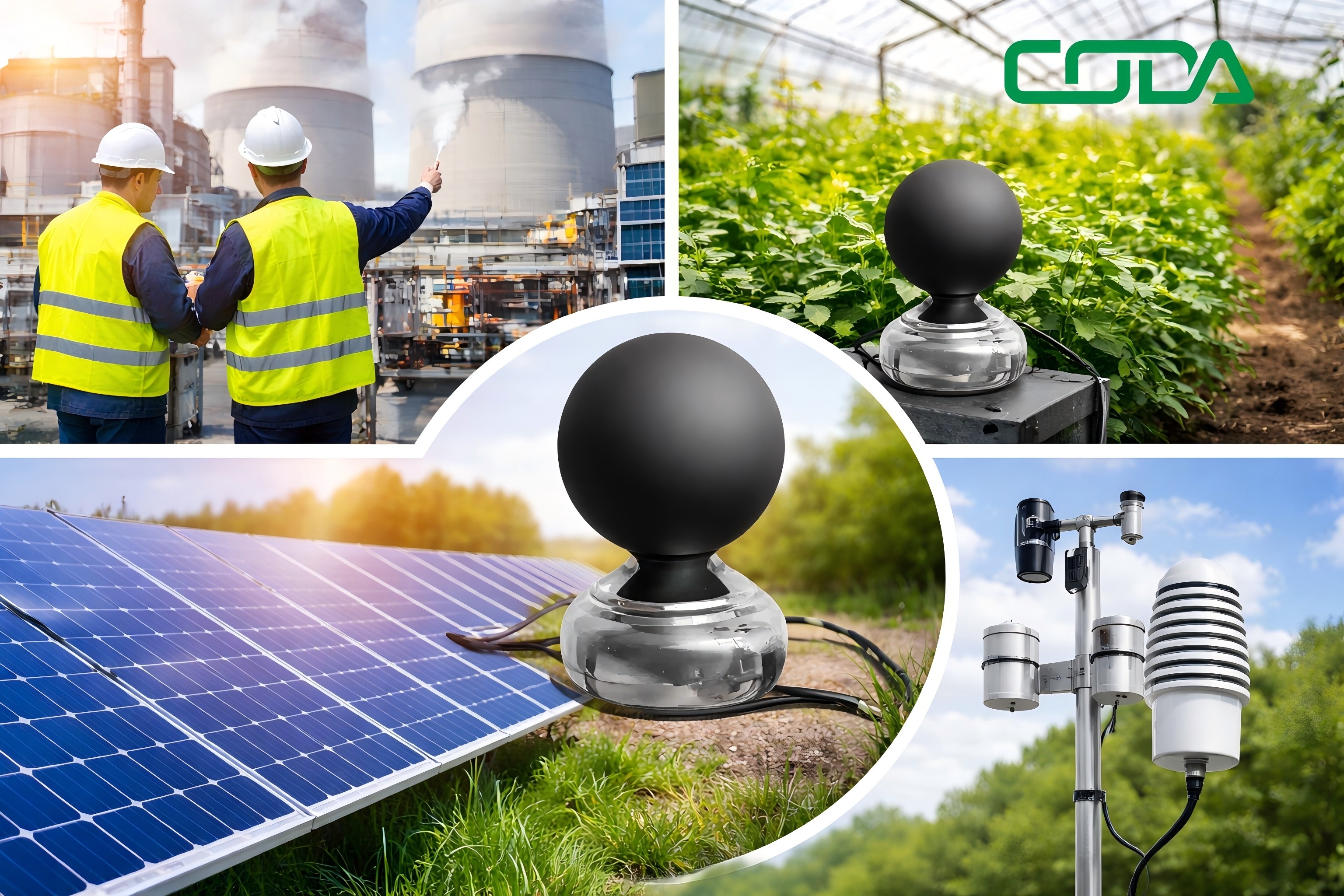
Construction sites, factories, mines, and steel plants often experience strong radiant heat. The CDW-11A helps monitor real thermal exposure and supports worker protection programs.
In greenhouses and open fields, radiant heat directly affects crops and livestock. Globe temperature data enables better irrigation control, shading strategies, and ventilation management, improving yield and quality.
Solar farms operate under intense sunlight and high surface temperatures. Monitoring radiant heat helps evaluate equipment performance and prevent overheating.
Meteorological systems benefit from more comprehensive temperature measurements. Globe temperature provides additional insight into climate conditions and heat stress trends.
Urban areas often experience heat island effects. Black globe sensors help measure real street-level heat exposure and support better urban planning decisions.
The CDW-11A is designed for easy installation and system compatibility. With standard outputs such as RS485 and 4–20 mA, it connects smoothly to PLCs, data loggers, SCADA systems, and cloud platforms.
Its rugged design reduces maintenance requirements, while stable performance ensures reliable long-term operation. This helps lower overall project costs and simplifies deployment.
When selecting a black globe temperature sensor, accuracy, durability, and integration flexibility are critical.
The CDW-11A offers:
Professional-grade measurement
Industrial durability
Flexible communication options
Reliable outdoor performance
Cost-effective operation
These advantages make it an excellent choice for occupational safety, agriculture, energy, and environmental monitoring projects.
Measuring air temperature alone is no longer sufficient for modern heat stress assessment. Real environmental heat comes from multiple sources, including radiation, convection, and surrounding surfaces.
A black globe temperature sensor captures all these effects and provides a complete picture of thermal exposure.
By using the CDW-11A Black Globe Temperature Sensor, organizations can improve safety, ensure WBGT compliance, protect workers, and make smarter operational decisions.
For any application where heat matters, globe temperature monitoring is not just helpful — it is essential.
What are the uses of a rain gauge? Learn how rai
Learn how PAR sensors measure PPFD, optimize gro
Learn how soil EC sensors help optimize fertiliz
Contact: Molly
Phone: +86-17775769236
Tel: 86-0731-85117089
Email: molly@codasensor.com
Add: Building S5, Aux Square, Yuelu District, Changsha City, Hunan Province, China
We chat






 English


