Modern weather stations are no longer limited to measuring temperature and humidity. Today’s environmental monitoring systems require more complete and real-time atmospheric data to support agriculture, renewable energy, scientific research, and smart city management.
One critical parameter that is often overlooked is solar radiation.
By integrating a pyranometer such as the CDG-10B Solar Radiation Sensor, weather stations can measure global solar irradiance accurately and continuously. This transforms a basic monitoring station into a professional, data-driven environmental solution.
A pyranometer is a meteorological radiation sensor used to measure total solar radiation reaching the Earth’s surface. It captures direct sunlight, diffuse sky radiation, and reflected light. The measurement is expressed in watts per square meter (W/m²), providing a clear indication of solar energy intensity.
This information is widely used for weather analysis, climate modeling, solar energy forecasting, crop management, and environmental research.
Without solar radiation data, weather stations provide only partial environmental insight.
Solar radiation directly influences air temperature, humidity, evaporation, and wind patterns. By monitoring sunlight intensity, meteorologists can better understand energy exchange within the atmosphere, leading to improved weather forecasting and more accurate climate studies.
Sunlight is one of the most important factors affecting crop growth. Monitoring solar radiation helps farmers and greenhouse operators optimize irrigation, shading, and fertilization schedules. With real-time light data, smart agriculture systems can reduce water consumption, improve crop quality, and increase overall yield.
For photovoltaic systems, irradiance measurement is essential. By comparing incoming solar radiation with power output, operators can evaluate panel efficiency, detect dust or shading issues, and identify equipment faults. Adding a pyranometer makes a weather station valuable for both meteorology and renewable energy management.
Universities, research institutes, and environmental agencies rely on complete environmental datasets. Solar radiation measurements support studies related to climate change, air quality, and ecosystem behavior. Including a radiation sensor improves the accuracy and credibility of research results.
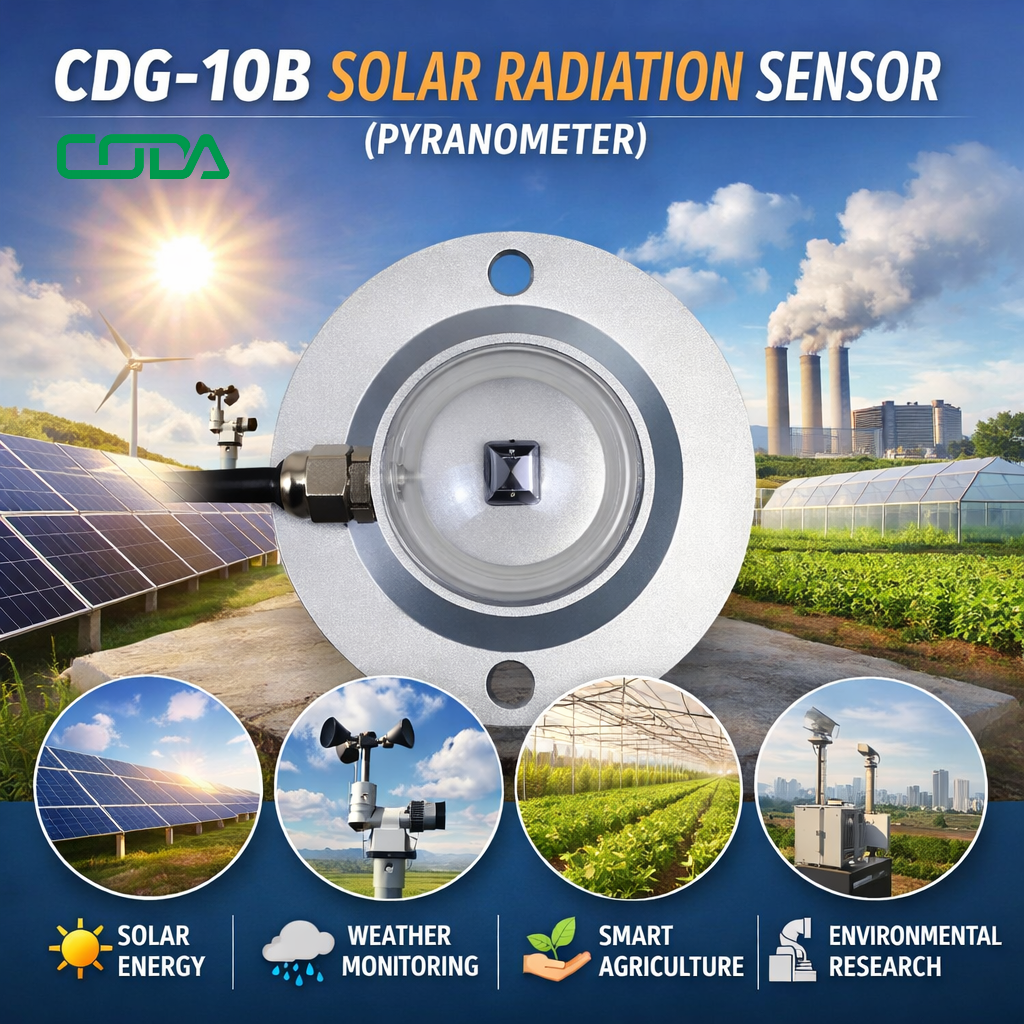
When selecting a pyranometer for outdoor deployment, reliability, durability, and easy integration are key considerations. The CDG-10B Solar Radiation Sensor is specifically designed for long-term environmental monitoring applications.
High accuracy and fast response time for real-time measurement of sunlight changes.
Silicon cell technology with no moving parts, ensuring low maintenance and long service life.
Low power consumption, suitable for remote and solar-powered stations.
Multiple output options including 0–5V, 4–20mA, and RS485 Modbus for easy integration with PLCs, dataloggers, and IoT platforms.
IP65 protection and rugged housing for stable operation in harsh outdoor environments.
A professional environmental monitoring station may include:
Temperature sensor
Humidity sensor
Barometric pressure sensor
Wind speed & direction sensor
Solar radiation sensor (pyranometer)
With the addition of the CDG-10B, the system becomes a complete meteorological solution, delivering comprehensive atmospheric data in one platform.
Weather stations equipped with pyranometers are widely used in meteorological stations, smart agriculture projects, solar farms, environmental monitoring networks, universities, research institutes, and smart city infrastructure.
As environmental monitoring requirements continue to grow, basic weather measurements are no longer sufficient. Solar radiation monitoring has become an essential parameter for accurate analysis and intelligent decision-making.
Integrating the CDG-10B Solar Radiation Sensor into a weather station provides reliable, real-time irradiance data while maintaining low maintenance and easy system integration. It is a practical and cost-effective way to upgrade any station into a professional-grade monitoring solution.
What are the uses of a rain gauge? Learn how rai
Learn how PAR sensors measure PPFD, optimize gro
Learn how soil EC sensors help optimize fertiliz
Contact: Molly
Phone: +86-17775769236
Tel: 86-0731-85117089
Email: molly@codasensor.com
Add: Building S5, Aux Square, Yuelu District, Changsha City, Hunan Province, China
We chat






 English


