Extreme weather events are becoming more frequent and unpredictable. Sudden heavy rainfall can flood fields within hours, while prolonged dry periods can lead to severe drought stress and reduced crop yields. For modern agriculture, relying on experience or visual observation alone is no longer enough.
Today, smart farms depend on accurate, real-time environmental data to make fast and informed decisions. Among all meteorological measurements, rainfall is one of the most critical factors directly affecting irrigation planning, soil moisture balance, and crop health.
By integrating a reliable rainfall monitoring system into an agricultural weather station, farmers can detect risks early, respond quickly, and protect both crops and investments. Tipping bucket rain gauges, in particular, have become an essential flood warning sensor and drought management tool for modern farming operations.
Rainfall patterns directly determine agricultural success or failure. Both excessive and insufficient precipitation can cause significant losses.
Heavy rainstorms may lead to:
Field flooding and waterlogging
Root oxygen deficiency
Soil erosion and nutrient loss
Crop damage or complete destruction
Delayed planting or harvesting
Even a few hours of uncontrolled rainfall can ruin weeks or months of work.
On the other hand, lack of rainfall can result in:
Soil moisture depletion
Reduced plant growth
Lower yields and poor crop quality
Increased irrigation costs
Long-term soil degradation
Without accurate rainfall data, farmers often either over-irriagate or under-irrigate, both of which reduce efficiency and increase expenses.
This is where rainfall sensors become critical.
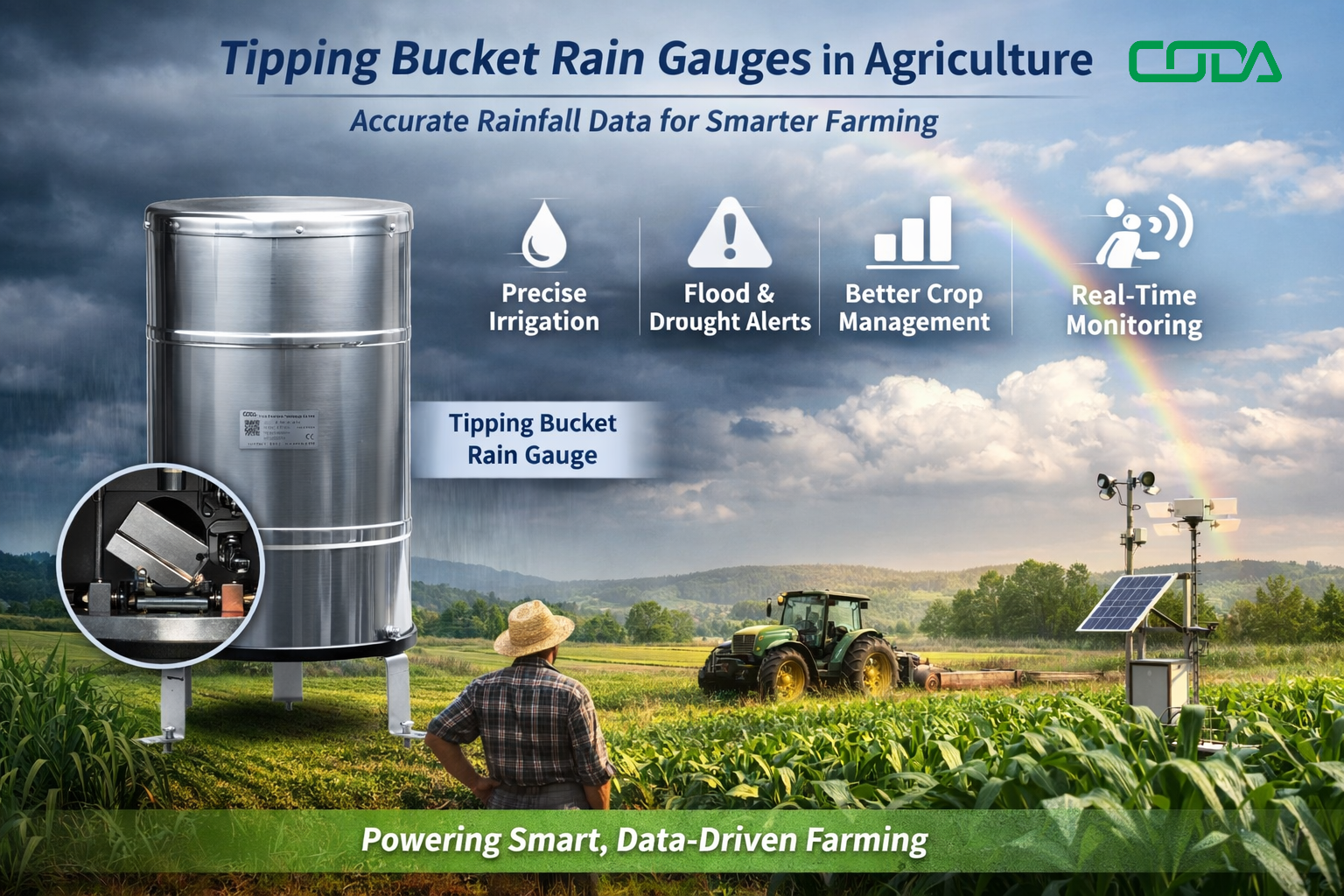
A rainfall monitoring system measures precipitation continuously and converts rainfall into digital signals for recording and analysis. Modern tipping bucket rain gauges provide high accuracy and long-term stability with minimal maintenance.
Rainwater is collected through a funnel and fills a small calibrated bucket. When the bucket reaches a preset volume, it tips and generates an electrical pulse. Each pulse corresponds to a fixed rainfall amount (such as 0.1 mm or 0.2 mm). By counting pulses, the system calculates total rainfall and intensity.
This simple but reliable mechanism makes tipping bucket rain gauges ideal for agricultural environments.
Accurate rainfall data helps farmers:
Track daily and seasonal precipitation
Adjust irrigation schedules
Prevent overwatering
Monitor storm intensity
Prepare for extreme events
Instead of guessing, farmers make decisions based on real numbers.
One of the biggest advantages of modern rainfall sensors is real-time monitoring and alerts.
When connected to a data logger or cloud platform, rainfall data can trigger automatic notifications.
If rainfall intensity exceeds a predefined threshold:
SMS or app alerts are sent immediately
Drainage systems can be activated
Workers can protect equipment
Sensitive crops can be covered
Early action reduces damage significantly.
If rainfall remains below normal levels for an extended period:
Irrigation schedules can be adjusted
Water resources can be allocated efficiently
Crops receive timely hydration
This proactive approach prevents stress before it impacts yields.
In short, rainfall sensors transform farms from reactive to proactive management.
Rainfall sensors are most powerful when integrated into a complete agricultural weather station.
A smart weather station may include:
Rain gauge sensor
Temperature and humidity sensor
Wind speed and wind direction sensor
Solar radiation sensor
Soil moisture or soil temperature sensors
When combined, these sensors provide a full picture of environmental conditions.
With RS485, Modbus, or wireless communication, rainfall data can be:
Uploaded to cloud platforms
Viewed remotely via smartphone or PC
Stored for historical analysis
Shared with agronomists or researchers
This allows 24/7 monitoring even when no one is physically on-site.
For large farms or remote agricultural areas, cloud-based rainfall monitoring greatly improves efficiency and safety.
A vegetable farm installed a rainfall monitoring system connected to automated irrigation. When sufficient rainfall was detected, irrigation stopped automatically.
Result:
30% water savings
Lower electricity costs
Healthier crops
A farm located near a river used rainfall sensors to trigger flood alerts. When heavy rain intensity increased, drainage pumps were activated early.
Result:
Reduced crop losses
Faster response time
Improved farm safety
A government agricultural project installed weather stations with rain gauges in remote areas. Data was uploaded to the cloud for centralized monitoring.
Result:
Better regional weather forecasting
Improved disaster prevention
Data-driven agricultural planning
These examples show that rainfall sensors are not just measurement tools — they are risk management solutions.
Integrating a rainfall monitoring system provides multiple advantages:
Early flood warnings
Reduced weather-related accidents
Better protection for equipment and workers
Smarter irrigation planning
Reduced water and energy waste
Lower operational costs
Optimal soil moisture control
Healthier plant growth
More stable production
Historical rainfall trends
Seasonal planning
Scientific farm management
Ultimately, reliable rainfall data supports both short-term protection and long-term sustainability.
As climate change increases the frequency of extreme weather, agricultural risk management is more important than ever. Accurate rainfall measurement is no longer optional — it is essential.
By installing tipping bucket rain gauges as part of an agricultural weather station, farmers gain real-time insights, early warnings, and the ability to act quickly against floods and droughts. These systems protect crops, save resources, and ensure safer and more productive farming operations.
A dependable rainfall sensor is not just a tool — it is an investment in farm resilience and future success.
What are the uses of a rain gauge? Learn how rai
Learn how PAR sensors measure PPFD, optimize gro
Learn how soil EC sensors help optimize fertiliz
Contact: Molly
Phone: +86-17775769236
Tel: 86-0731-85117089
Email: molly@codasensor.com
Add: Building S5, Aux Square, Yuelu District, Changsha City, Hunan Province, China
We chat






 English


