Modern greenhouse farming has evolved far beyond traditional cultivation methods. Today’s growers rely on precision agriculture technologies to control environmental parameters such as temperature, humidity, light, and carbon dioxide concentration. Among these variables, carbon dioxide (CO₂) plays one of the most critical roles in plant growth and productivity.
A reliable greenhouse CO₂ sensor is no longer optional—it is a fundamental component of any smart agriculture system. Accurate and real-time CO₂ monitoring allows growers to optimize photosynthesis, increase crop yield, reduce operational costs, and maintain stable climate control inside the greenhouse.
This article explores why CO₂ monitoring is essential for smart greenhouse farming and how the CDW-12A CO₂ sensor helps growers achieve higher efficiency and better economic returns.
Photosynthesis is the biological process through which plants convert carbon dioxide, water, and sunlight into glucose and oxygen. CO₂ is not just a supplementary factor—it is one of the three primary ingredients required for plant growth.
The simplified photosynthesis equation:
6 CO₂ + 6 H₂O + Light Energy → C₆H₁₂O₆ + 6 O₂
Without sufficient CO₂, plants cannot efficiently produce carbohydrates, which directly affects:
Leaf development
Stem growth
Root strength
Flowering and fruiting
Overall biomass production
In natural outdoor environments, atmospheric CO₂ levels typically range between 400–420 ppm. However, in a closed greenhouse environment, CO₂ concentration can quickly drop below optimal levels due to plant absorption—especially during peak sunlight hours.
When CO₂ levels fall below 300 ppm, photosynthesis slows significantly. If levels drop further, plant growth can stagnate.
This is why a precise CO₂ monitoring system is essential. Real-time data ensures that greenhouse managers can maintain the correct concentration range for maximum photosynthetic efficiency.
Different crops respond differently to elevated CO₂ concentrations. In controlled greenhouse environments, growers often increase CO₂ levels above ambient atmospheric conditions to enhance productivity.
Here are general optimal ranges:
| Crop Type | Recommended CO₂ Level |
|---|---|
| Leafy Greens (Lettuce, Spinach) | 800–1,000 ppm |
| Tomatoes | 1,000–1,200 ppm |
| Cucumbers | 900–1,200 ppm |
| Peppers | 1,000–1,300 ppm |
| Strawberries | 800–1,000 ppm |
| Cannabis (where legal) | 1,200–1,500 ppm |
Studies show that maintaining CO₂ levels between 800–1,200 ppm can increase crop yields by 20%–40% under optimal light and temperature conditions.
However, maintaining this balance requires accurate and continuous monitoring. Over-enrichment wastes resources and increases operational costs, while under-supply reduces yield potential.
This is where a professional-grade greenhouse CO₂ sensor becomes indispensable.
When CO₂ concentration is too low:
Photosynthesis rate decreases
Plant growth slows
Leaves may become thinner and smaller
Fruit production declines
Overall crop cycle length increases
Low CO₂ often occurs during sunny days when plants rapidly consume carbon dioxide inside a sealed greenhouse.
Without monitoring, growers may not detect this invisible limitation factor until reduced yields become evident.
While elevated CO₂ improves growth within a certain range, excessive levels can cause:
Plant stress
Reduced nutrient absorption
Increased operational costs
Worker safety risks (above 5,000 ppm becomes hazardous for humans)
Over-injection of CO₂ without accurate monitoring leads to unnecessary expenditure on gas supply and potential safety concerns.
A high-precision CO₂ monitoring system ensures CO₂ remains within the optimal window—maximizing growth while protecting both crops and workers.
The CDW-12A CO₂ sensor is specifically designed for environmental monitoring applications, including greenhouse farming. Built with advanced NDIR (Non-Dispersive Infrared) technology, it provides high accuracy, long-term stability, and reliable real-time measurements.
NDIR sensors measure CO₂ concentration based on infrared light absorption. Compared to traditional electrochemical sensors, NDIR offers:
Superior long-term stability
Reduced drift
Higher accuracy
Longer service life
This makes it ideal for continuous greenhouse deployment.
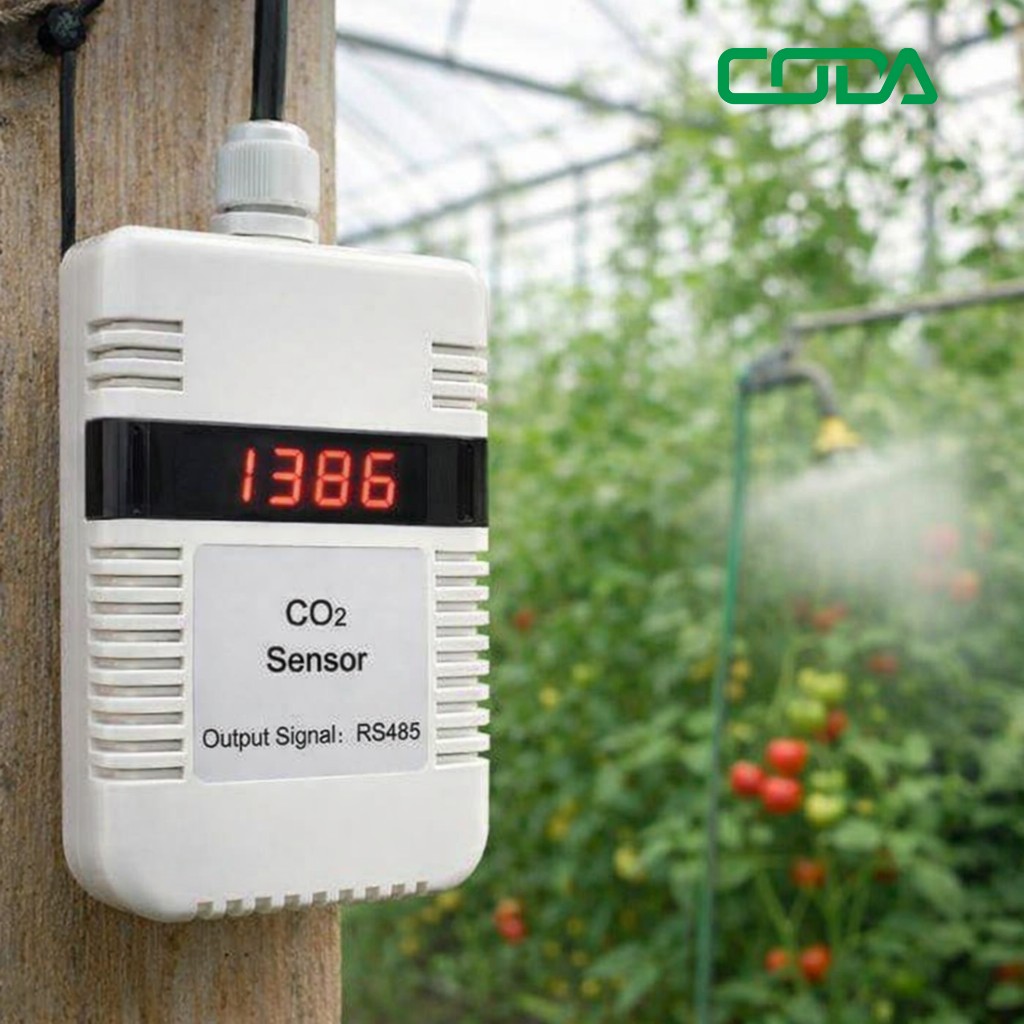
The CDW-12A delivers continuous CO₂ concentration readings, enabling:
Immediate detection of fluctuations
Timely CO₂ enrichment adjustments
Prevention of under-supply during peak photosynthesis hours
Real-time monitoring ensures climate stability throughout the crop growth cycle.
The sensor supports RS485 Modbus output, allowing seamless integration into:
Greenhouse climate control systems
Smart agriculture IoT platforms
Environmental monitoring networks
Data loggers and PLC systems
RS485 communication ensures stable long-distance data transmission with strong anti-interference capability—ideal for large commercial greenhouse operations.
The CDW-12A offers multiple range options (e.g., 0–2000 ppm, 0–5000 ppm, 0–10000 ppm), allowing growers to select the appropriate configuration for their crop type and enrichment strategy.
Greenhouses present unique challenges:
High humidity
Fertilizer vapors
Temperature fluctuations
The CDW-12A is designed for stable performance in such demanding conditions, ensuring reliable long-term operation.
Modern smart greenhouse systems rely on automated environmental control.
A smart agriculture sensor like the CDW-12A can be integrated into:
When CO₂ levels fall below a preset threshold:
The system automatically activates CO₂ generators or tanks
Concentration rises to target level
Injection stops once optimal concentration is reached
This prevents waste and ensures precise control.
During hot weather, ventilation fans reduce temperature—but may also lower CO₂ concentration.
By integrating CO₂ sensors with ventilation controls:
Systems balance temperature and CO₂ levels
CO₂ injection compensates for losses
Energy efficiency improves
Through IoT integration, greenhouse operators can:
Monitor CO₂ levels remotely
Analyze historical data trends
Optimize enrichment schedules
Improve long-term crop planning
Data-driven agriculture enhances productivity while minimizing input costs.
Investing in a professional CO₂ monitoring system is not merely a technical upgrade—it is a strategic financial decision.
Controlled CO₂ enrichment can increase crop yields by 20–40%, depending on crop type and environmental conditions.
For commercial growers, even a 10% yield increase can significantly impact annual revenue.
Elevated CO₂ accelerates plant development, allowing:
Shorter harvest cycles
More production cycles per year
Higher overall output
Accurate monitoring prevents:
Excess CO₂ injection
Energy waste
Unnecessary gas consumption
This directly lowers operational costs.
Optimized CO₂ levels can improve:
Fruit size
Uniformity
Sugar content
Market value
High-quality produce commands premium prices in competitive markets.
The CDW-12A’s stable NDIR technology minimizes maintenance frequency and calibration requirements, reducing downtime and service costs.
As smart agriculture continues to evolve, precision environmental control will become even more critical. With increasing global demand for food production and sustainable farming practices, greenhouse operators must maximize efficiency while minimizing environmental impact.
Advanced CO₂ monitoring solutions like the CDW-12A play a central role in:
Sustainable agriculture
Data-driven crop management
Automated climate systems
Intelligent greenhouse ecosystems
By integrating reliable CO₂ sensors into greenhouse infrastructure, growers gain full control over one of the most influential variables in plant productivity.
Carbon dioxide is the engine of photosynthesis—and therefore the engine of greenhouse productivity. Without accurate monitoring, growers risk reduced yields, wasted resources, and unstable growing conditions.
A high-quality greenhouse CO₂ sensor like the CDW-12A provides the precision, stability, and integration capabilities required for modern smart farming systems. By maintaining optimal CO₂ levels, growers can enhance crop yield, improve quality, reduce costs, and achieve sustainable long-term profitability.
In today’s competitive agricultural landscape, smart CO₂ monitoring is not just an advantage—it is a necessity.
What are the uses of a rain gauge? Learn how rai
Learn how PAR sensors measure PPFD, optimize gro
Learn how soil EC sensors help optimize fertiliz
Contact: Molly
Phone: +86-17775769236
Tel: 86-0731-85117089
Email: molly@codasensor.com
Add: Building S5, Aux Square, Yuelu District, Changsha City, Hunan Province, China
We chat






 English


