In today’s fast-evolving world of intelligent transportation, safety, efficiency, and data-driven decision-making are more important than ever. Whether in logistics, emergency response, agriculture, or road maintenance, understanding environmental conditions in real time can make a critical difference. This is where vehicle-mount weather stations come into play.
Unlike traditional fixed weather stations, vehicle-mounted systems are designed to collect atmospheric data while on the move. Installed directly on cars, trucks, or specialized vehicles, these systems provide dynamic, location-specific weather insights that static stations simply cannot offer.
This article explores the technology, applications, benefits, and future potential of vehicle-mount weather stations, helping you understand why they are becoming essential tools across multiple industries.
A vehicle-mount weather station is a compact, integrated system installed on a moving vehicle to measure environmental parameters in real time. These systems typically include multiple sensors and a communication module to transmit data to onboard systems or cloud platforms.
Real-time data collection while in motion
Compact and rugged design for harsh environments
Multi-parameter sensing capability
Wireless or wired data transmission
GPS integration for geolocation tagging
Unlike fixed weather stations that monitor a single location, vehicle-mounted systems provide continuous environmental mapping across wide areas.
Vehicle-mounted weather stations are equipped with various sensors to capture critical atmospheric data. Common parameters include:
Essential for road safety, especially for high-profile vehicles
Helps detect crosswinds and hazardous driving conditions
Supports climate monitoring and vehicle performance optimization
Important for cold chain logistics and agricultural transport
Useful for weather prediction and altitude-related adjustments
Real-time precipitation data for road condition monitoring
Important for photovoltaic system analysis and agricultural studies
Ice detection, wetness, and surface temperature for winter maintenance
Vehicle-mounted weather stations play a vital role in smart transportation networks. By collecting real-time environmental data, they help:
Improve traffic management
Enhance driver safety
Provide data for predictive analytics
For example, fleets equipped with these systems can alert drivers about sudden weather changes along their routes.
Government agencies and highway maintenance teams use vehicle-mounted systems to monitor road conditions dynamically.
Detect icy or slippery roads
Optimize snowplow and de-icing operations
Reduce accident risks
Instead of relying solely on fixed stations, mobile units provide hyper-local insights across entire road networks.
For logistics companies, environmental conditions can directly impact delivery times and product quality.
Cold chain monitoring (temperature-sensitive goods)
Route optimization based on weather conditions
Risk management for hazardous weather
Real-time weather data allows fleet managers to make informed decisions, improving efficiency and reducing losses.
Emergency vehicles equipped with weather stations can provide crucial data during natural disasters such as:
Storms
Wildfires
Floods
This data helps response teams assess risks and coordinate operations more effectively.
In agricultural applications, vehicle-mounted weather stations enable:
Field-level microclimate monitoring
Precision farming decisions
Crop health analysis
Farm vehicles equipped with sensors can collect data across large areas, offering insights that stationary stations cannot.
For solar and wind energy projects, mobile weather stations help in:
Site assessment
Performance monitoring
Environmental impact studies
They are particularly useful during the pre-installation phase of renewable energy systems.
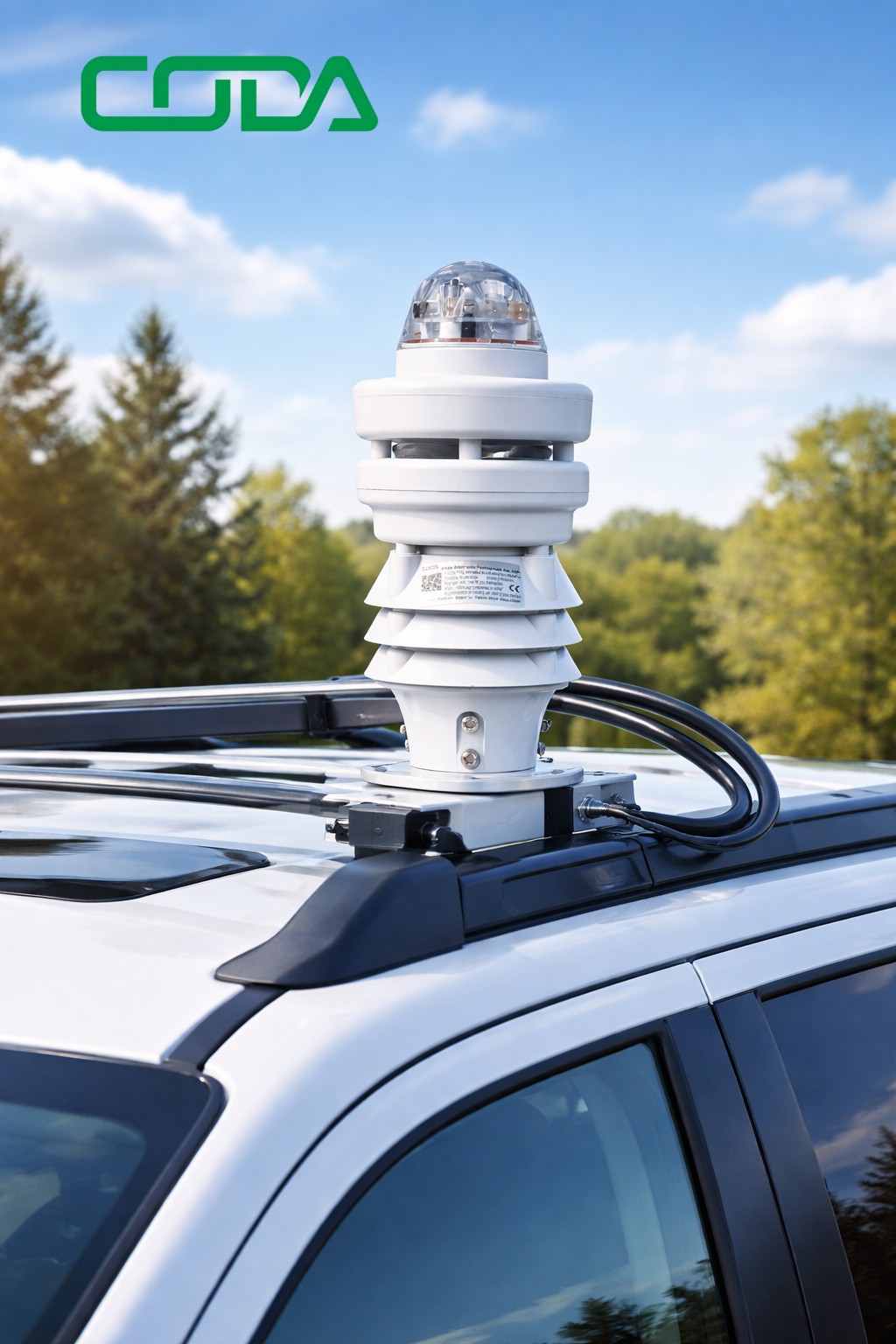
Vehicle-mounted systems can cover vast areas, providing spatially rich datasets.
Instant data transmission enables immediate action in dynamic environments.
Fewer fixed stations are needed when mobile units can supplement data collection.
Easily installed on different types of vehicles, from passenger cars to heavy-duty trucks.
Provides localized data that improves accuracy in weather modeling and forecasting.
A typical vehicle-mount weather station consists of:
Includes wind, temperature, humidity, pressure, and optional sensors.
Aerodynamic design to minimize interference
مقاust materials for durability
Collects and processes sensor data
May support protocols like RS485 (Modbus) or SDI-12
4G/5G, LoRa, or Wi-Fi
Enables cloud integration and remote monitoring
Vehicle battery integration or independent power source
While vehicle-mounted weather stations offer many advantages, there are also challenges to consider:
Movement can introduce measurement errors
Requires advanced calibration and compensation algorithms
Poor placement can affect wind and radiation measurements
Heat from the vehicle or exhaust can impact readings
Regular calibration and cleaning are necessary for optimal performance
Recent innovations are enhancing the capabilities of vehicle-mounted weather stations:
Seamless connection to cloud platforms
Real-time dashboards and analytics
Predictive modeling based on collected data
Automated alerts and decision support
Onboard data processing for faster response times
Improved energy efficiency
Easier installation and deployment
The future of vehicle-mounted weather stations is closely tied to the development of smart cities and autonomous vehicles.
Integration with autonomous driving systems
Expansion of connected vehicle networks
Increased use in environmental monitoring
Enhanced sensor accuracy and miniaturization
As transportation systems become more intelligent, real-time environmental data will be a core component of decision-making processes.
Vehicle-mount weather stations are transforming the way we collect and use environmental data. By enabling real-time, mobile weather monitoring, they provide critical insights that improve safety, efficiency, and operational performance across multiple industries.
From smart transportation and logistics to agriculture and disaster response, these systems are proving to be indispensable tools in a data-driven world. As technology continues to evolve, vehicle-mounted weather stations will play an even greater role in shaping the future of intelligent mobility and environmental monitoring.
What are the uses of a rain gauge? Learn how rai
Learn how PAR sensors measure PPFD, optimize gro
Learn how soil EC sensors help optimize fertiliz
Contact: Molly
Phone: +86-17775769236
Tel: 86-0731-85117089
Email: molly@codasensor.com
Add: Building S5, Aux Square, Yuelu District, Changsha City, Hunan Province, China
We chat






 English


