Modern agriculture is rapidly evolving from traditional farming methods to intelligent, data-driven management systems. As climate change, water shortages, labor costs, and food demand continue to increase, farmers are under growing pressure to improve productivity while reducing operational risks and resource consumption.
This is where smart agriculture sensors play a critical role.
By collecting real-time environmental data, smart agriculture monitoring systems help farmers make more accurate decisions related to irrigation, fertilization, greenhouse climate control, and crop management.
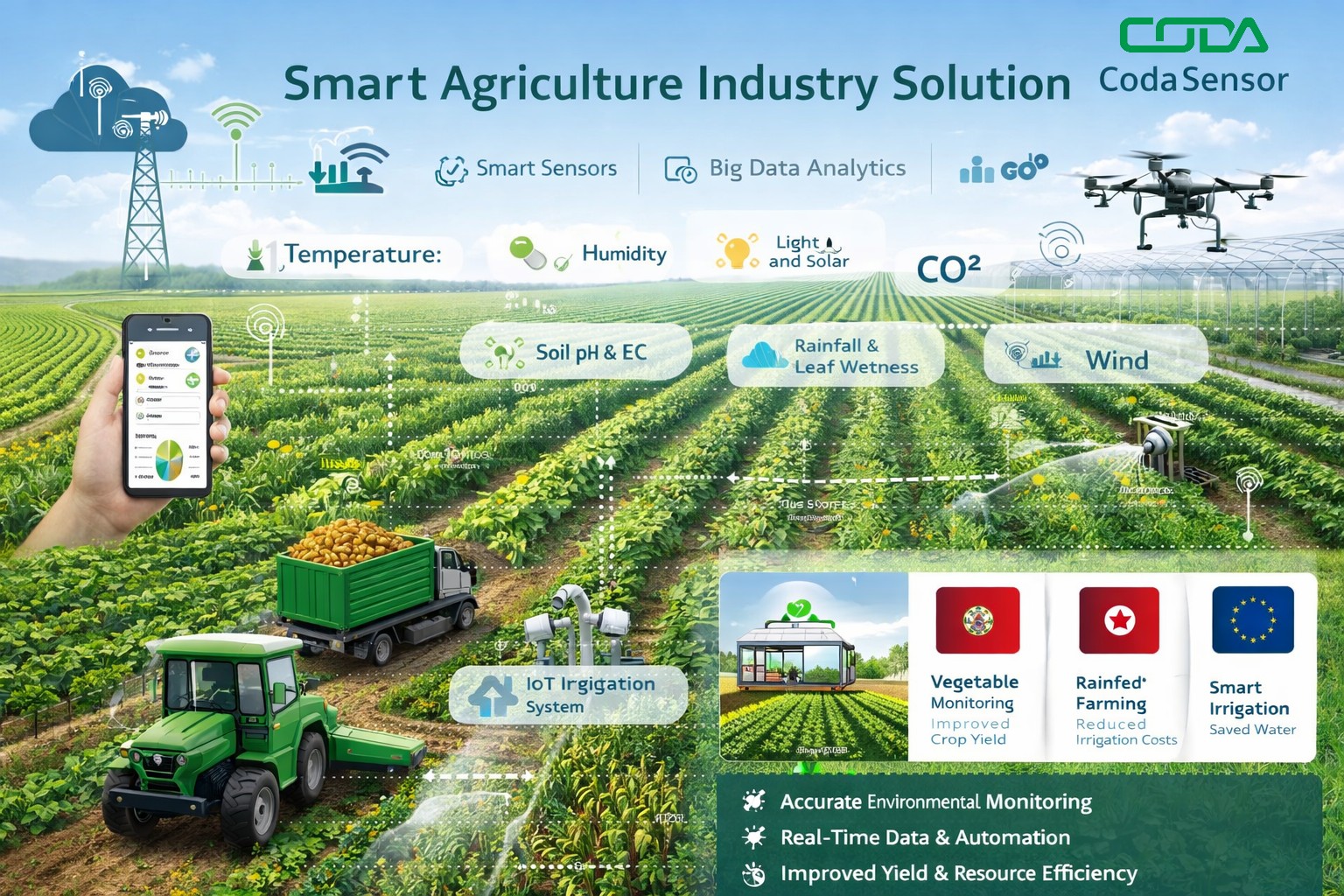
Today’s intelligent farms use a wide range of sensors to monitor essential environmental parameters such as:
Soil moisture
Soil EC
Soil pH
Temperature
Humidity
Rainfall
CO₂ concentration
These smart agriculture sensors provide the foundation for precision farming and greenhouse automation.
In this article, we’ll explore the most important agricultural parameters farmers should monitor, how different sensors work, and how smart agriculture systems improve modern farming efficiency.
A smart agriculture monitoring system is an integrated platform that uses environmental sensors, IoT communication, cloud software, and automation technologies to monitor and manage farming conditions in real time.
These systems are widely used in:
Open-field farming
Smart greenhouses
Vertical farming
Fruit plantations
Vineyard monitoring
Irrigation management
Hydroponic farming
Modern systems often support:
RS485 Modbus RTU communication
Wireless transmission
Cloud monitoring platforms
Mobile applications
Real-time alarms
Remote automation control
Crop growth is highly sensitive to environmental conditions.
Even small environmental fluctuations can affect:
Crop quality
Yield
Water consumption
Nutrient absorption
Disease development
Traditional farming methods often rely on experience-based decisions. However, smart agriculture systems provide accurate environmental data that allows farmers to optimize operations scientifically.
Benefits of agricultural monitoring include:
✅ Improved irrigation efficiency
✅ Reduced fertilizer waste
✅ Better crop quality
✅ Lower labor costs
✅ Disease prevention
✅ Increased productivity
✅ Water conservation
Soil moisture monitoring is one of the most important aspects of precision agriculture.
A soil moisture sensor measures the amount of water present in the soil.
Both overwatering and underwatering can damage crops.
Poor irrigation management may lead to:
Root diseases
Nutrient loss
Reduced crop growth
Water waste
Real-time soil moisture monitoring helps farmers:
✅ Optimize irrigation schedules
✅ Reduce water consumption
✅ Improve crop consistency
✅ Prevent water stress
Soil moisture sensors are widely used in:
Greenhouses
Fruit farms
Vegetable cultivation
Smart irrigation systems
EC stands for electrical conductivity.
Soil EC sensors measure the concentration of soluble salts and nutrients in the soil.
EC values help farmers understand:
Fertilizer concentration
Nutrient availability
Salinity levels
Excessively high EC levels may:
Damage roots
Reduce water absorption
Affect crop growth
Low EC values may indicate insufficient nutrients.
Greenhouse cultivation
Hydroponics
Precision fertilization
Smart irrigation management
Monitoring soil EC helps farmers optimize fertilizer usage and improve nutrient management.
Soil pH affects nutrient absorption and microbial activity.
Different crops require different pH conditions for optimal growth.
Improper pH levels can:
Reduce nutrient availability
Affect root development
Increase disease risk
Most crops prefer pH levels between:
5.5 to 7.5
Continuous soil pH monitoring helps farmers:
✅ Improve fertilization strategies
✅ Optimize crop growth conditions
✅ Prevent nutrient imbalance
Soil pH sensors are especially important for greenhouse cultivation and high-value crops.
Temperature directly affects plant growth and crop development.
Agricultural temperature sensors monitor ambient environmental temperature in real time.
Extreme temperatures may:
Damage crops
Slow plant growth
Reduce pollination
Increase water stress
Greenhouses
Open-field farming
Seedling cultivation
Smart irrigation systems
Real-time temperature monitoring allows farmers to adjust irrigation, ventilation, and greenhouse systems accordingly.
Humidity sensors measure moisture levels in the air.
Temperature and humidity are often monitored together in greenhouse systems.
Excessive humidity may cause:
Mold growth
Plant diseases
Fungal infections
Low humidity may lead to:
Excessive water evaporation
Plant stress
Humidity monitoring helps farmers:
✅ Improve greenhouse climate control
✅ Reduce disease risks
✅ Optimize crop conditions
Rainfall monitoring is essential for irrigation planning and water resource management.
Rainfall sensors help farmers understand natural precipitation conditions.
Rainfall data helps avoid:
Over-irrigation
Water waste
Soil erosion
Smart irrigation systems
Open-field farming
Vineyard management
Weather stations
Modern rainfall sensors are often integrated into agricultural weather stations.
CO₂ concentration significantly affects photosynthesis and crop productivity.
Greenhouse operators increasingly use CO₂ sensors to optimize growing environments.
Insufficient CO₂ may limit:
Plant growth
Crop yield
Photosynthesis efficiency
Proper CO₂ levels can improve:
Growth speed
Yield quality
Production efficiency
Smart greenhouses
Hydroponic systems
Indoor farming
Modern greenhouse monitoring systems often automate CO₂ control systems based on real-time sensor data.
Modern greenhouse monitoring systems combine multiple environmental sensors into one centralized platform.
These systems help farmers monitor:
Soil conditions
Climate conditions
Irrigation performance
Air quality
Integrated systems often support:
Remote monitoring
Cloud platforms
Mobile apps
Automatic alarms
Automation control
A commercial greenhouse farm implemented a smart agriculture monitoring system to improve tomato production efficiency.
The farm experienced:
Uneven irrigation
Inconsistent greenhouse climate
High labor requirements
Disease outbreaks caused by humidity fluctuations
The greenhouse deployed:
Soil moisture sensors
Soil EC sensors
Temperature and humidity sensors
CO₂ sensors
Automatic irrigation control system
All environmental data was uploaded to a cloud monitoring platform.
The farm achieved:
✅ Reduced water consumption
✅ Improved crop consistency
✅ Better greenhouse climate stability
✅ Lower labor costs
✅ Increased tomato yield
Real-time monitoring significantly improved greenhouse management efficiency.
A vineyard installed an agricultural weather monitoring system to optimize irrigation and disease prevention.
The vineyard faced:
Unpredictable rainfall
Water management difficulties
Crop disease risks
Manual environmental monitoring limitations
The project integrated:
Rainfall sensors
Soil moisture sensors
Temperature sensors
Humidity sensors
Weather monitoring station
The system provided real-time environmental analysis and irrigation recommendations.
The vineyard achieved:
✅ Improved irrigation efficiency
✅ Reduced water waste
✅ Better disease prevention
✅ Improved grape quality
✅ More efficient environmental management
Historical environmental data also helped improve seasonal cultivation strategies.
Agriculture is becoming increasingly digital and automated.
Future trends include:
AI-powered farming analysis
IoT smart agriculture platforms
Wireless sensor networks
Drone integration
Automated irrigation systems
Cloud-based environmental analysis
Environmental sensors will continue playing a central role in precision farming and sustainable agriculture.
Smart agriculture sensors are devices used to monitor environmental conditions such as soil moisture, temperature, humidity, EC, pH, rainfall, and CO₂ levels.
Soil moisture monitoring helps farmers optimize irrigation, reduce water waste, and improve crop health.
A soil EC sensor measures electrical conductivity, which reflects nutrient and salt concentration in the soil.
CO₂ sensors help optimize photosynthesis and improve crop productivity inside greenhouse environments.
Yes. Modern systems support cloud platforms, mobile applications, and remote monitoring technologies.
Smart agriculture sensors are transforming modern farming through real-time environmental monitoring and precision management.
By monitoring key parameters such as soil moisture, EC, pH, temperature, humidity, rainfall, and CO₂ concentration, farmers can improve productivity, reduce resource waste, and optimize crop quality.
As agriculture continues moving toward intelligent automation, smart greenhouse monitoring systems and environmental sensors will become increasingly essential for sustainable farming worldwide.
What are the uses of a rain gauge? Learn how rai
Learn how PAR sensors measure PPFD, optimize gro
Learn how soil EC sensors help optimize fertiliz
Contact: Molly
Phone: +86-17775769236
Tel: 86-0731-85117089
Email: molly@codasensor.com
Add: Building S5, Aux Square, Yuelu District, Changsha City, Hunan Province, China
We chat






 English


