Modern agriculture is increasingly driven by data and precision technology. Farmers today rely on advanced monitoring tools to improve productivity, reduce costs, and protect crops from environmental risks. One of the most important tools in this transformation is the agricultural weather station, which collects real-time environmental data such as temperature, humidity, rainfall, solar radiation, wind speed, and wind direction.
Among these parameters, wind direction data plays a crucial role in several farming activities. By understanding how air moves across a field, farmers can make better decisions about pesticide application, irrigation strategies, crop protection, and disease prevention.
A wind direction sensor, also known as a wind vane sensor, measures the direction from which the wind is blowing. When integrated into a modern agricultural weather station, this sensor provides valuable insights that help farmers manage their operations more efficiently.
This article explores how wind sensors for farming improve agricultural productivity and why wind direction monitoring is becoming an essential part of smart agriculture systems.
A wind direction sensor is a meteorological instrument designed to determine the direction of airflow. It typically consists of a rotating vane that aligns itself with the wind. As the wind pushes the vane, the sensor detects its position and converts it into an electrical signal.
Modern wind sensors are equipped with advanced electronics that convert the mechanical movement into digital signals such as RS485, 4–20 mA, or 0–5 V outputs, which can be transmitted to data loggers, controllers, or cloud platforms.
In agricultural weather stations, these sensors continuously record wind direction data, allowing farmers and agronomists to analyze environmental patterns over time.
Key advantages of modern wind sensors include:
High measurement accuracy
Real-time monitoring capability
Durable design for outdoor environments
Easy integration with IoT-based agricultural systems
Because wind directly affects how particles, moisture, and temperature move across farmland, wind monitoring has become a vital component of precision farming.
An agricultural weather station collects and analyzes environmental data to help farmers make better decisions. These stations often include sensors for:
Temperature
Relative humidity
Rainfall
Solar radiation
Soil moisture
Wind speed
Wind direction
By combining all these measurements, farmers can monitor microclimate conditions in their fields.
For example, weather data can help determine:
The best time to irrigate crops
The safest moment to apply pesticides
The likelihood of plant disease outbreaks
The optimal conditions for plant growth
Among these variables, wind direction data provides unique insights into airflow patterns across farmland.
One of the most critical agricultural applications of wind direction sensors is pesticide spraying management.
Pesticides are often applied using sprayers that distribute fine droplets over crops. If wind conditions are not properly monitored, these droplets can drift away from the target area. This phenomenon, known as spray drift, can cause several problems:
Reduced pesticide effectiveness
Environmental contamination
Damage to neighboring crops
Health risks for farm workers
By monitoring wind direction using a wind sensor for farming, farmers can determine the safest spraying conditions.
For example:
Spraying should be avoided when wind blows toward nearby residential areas.
Farmers can align spraying routes based on wind direction to ensure even coverage.
Real-time wind monitoring helps avoid chemical waste.
Using wind direction data from an agricultural weather station, farmers can significantly improve spraying accuracy while minimizing environmental impact.
Wind direction also influences evaporation rates and water distribution, which directly affects irrigation efficiency.
Strong winds can cause irrigation water to evaporate before it reaches plant roots. Wind direction information helps farmers adjust irrigation schedules and methods to reduce water loss.
For example:
Drip irrigation systems can be optimized when wind conditions are known.
Sprinkler irrigation can be scheduled during low-wind periods.
Wind direction patterns can help determine which areas of the field receive less moisture.
In regions facing water scarcity, efficient irrigation management is essential. By integrating wind monitoring into their agricultural weather station, farmers can reduce water waste and improve crop hydration.
Wind direction data also plays a critical role in crop protection and disease prevention.
Many plant diseases are spread by airborne spores that travel through the wind. Understanding wind patterns can help farmers predict how diseases might spread across fields.
For instance:
If a disease outbreak occurs in one section of a farm, wind direction data can help predict which areas are most at risk.
Farmers can apply targeted treatments in high-risk zones before infections spread.
Wind monitoring supports early warning systems for agricultural disease management.
In addition, wind direction sensors help protect crops from extreme weather events. During storms, strong winds can damage plants, greenhouses, and irrigation systems. Early monitoring allows farmers to prepare protective measures.
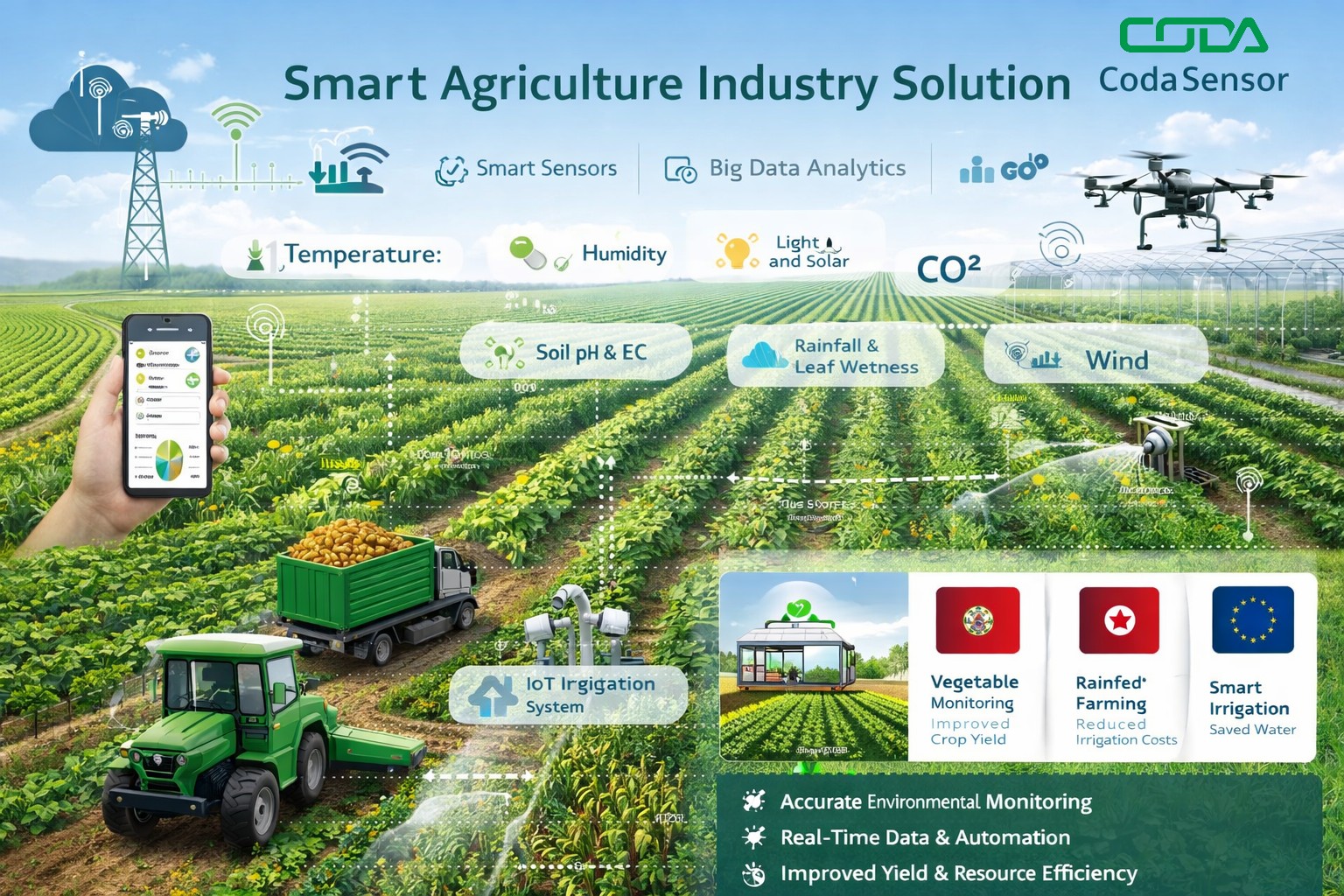
Precision agriculture relies on advanced technologies such as IoT sensors, cloud computing, and data analytics to optimize farming practices.
A wind direction sensor integrated with smart agriculture platforms enables continuous environmental monitoring. Data collected by the sensor can be transmitted to farm management software or cloud platforms, allowing farmers to analyze trends and automate decisions.
For example:
Automated irrigation systems can adjust schedules based on wind conditions.
Spraying equipment can be programmed to operate only when wind direction is safe.
Data analytics can identify seasonal wind patterns that affect crop productivity.
As farms become more connected through digital technologies, wind monitoring will play an even greater role in agricultural automation.
To obtain accurate data, wind direction sensors must be installed correctly. Proper installation ensures reliable measurements and long-term performance.
Important installation guidelines include:
Mount the sensor in an open area without obstacles such as trees or buildings.
Install the sensor at a suitable height to avoid airflow interference.
Align the sensor with true north to ensure accurate directional readings.
Ensure the mounting structure is stable to prevent vibration errors.
Regular maintenance, such as cleaning debris from the sensor, also helps maintain measurement accuracy.
Integrating wind sensors into agricultural monitoring systems offers many benefits:
Real-time wind data allows farmers to make informed decisions about spraying, irrigation, and field operations.
Monitoring wind patterns helps reduce the spread of pests and diseases.
Wind monitoring minimizes unnecessary pesticide and water use.
Accurate spraying reduces chemical drift and environmental contamination.
Data-driven farming practices lead to improved productivity and better crop yields.
As agricultural technology continues to evolve, wind monitoring systems are becoming more advanced.
Future developments may include:
Integration with AI-based farming platforms
Advanced predictive weather modeling
Wireless sensor networks across large farms
Fully automated agricultural decision systems
These technologies will make wind sensors for farming even more valuable for modern agriculture.
Wind direction monitoring plays a vital role in modern agricultural management. By integrating a wind direction sensor into an agricultural weather station, farmers gain valuable insights into environmental conditions affecting their crops.
From pesticide spraying optimization to irrigation planning and disease prevention, wind data helps farmers make smarter decisions that improve efficiency and sustainability.
As agriculture continues to adopt digital technologies, wind monitoring will remain a key component of precision farming systems. With accurate environmental data, farmers can protect crops, conserve resources, and increase productivity in an increasingly complex agricultural landscape.
What are the uses of a rain gauge? Learn how rai
Learn how PAR sensors measure PPFD, optimize gro
Learn how soil EC sensors help optimize fertiliz
Contact: Molly
Phone: +86-17775769236
Tel: 86-0731-85117089
Email: molly@codasensor.com
Add: Building S5, Aux Square, Yuelu District, Changsha City, Hunan Province, China
We chat






 English


