Which technology wins the battle for your tank? A deep dive into signal stability, environmental adaptability, and Total Cost of Ownership (TCO).
In the world of industrial automation and water management, selecting the right level sensor is rarely about finding the "best" technology on paper. It is about finding the right technology for the specific chaos of your environment.
Three contenders dominate the market: Ultrasonic, Radar, and Hydrostatic Pressure (Submersible) sensors. Each has its loyalists, but how do they stack up when conditions get tough?
This article moves beyond basic principles to compare these technologies in real-world scenarios—involving foam, vapors, outdoor elements, and budget constraints—to help you make the right investment.
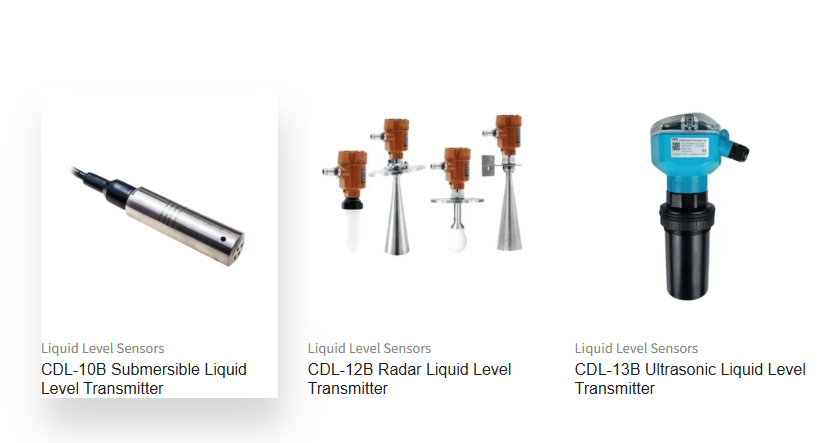
Ultrasonic Water level Sensors: The Cost-Effective "Listener" Principle: Emits sound waves that bounce off the liquid surface. The time of flight determines the distance. The Vibe: Economical, non-contact, and widely available. Great for simple water storage and chemical tanks.
Radar Water level Sensors: The All-Weather "Beast" Principle: Emits electromagnetic waves (microwaves). Like ultrasonic, it measures time of flight, but microwaves travel at the speed of light and are less affected by the atmosphere. The Vibe: High performance, high accuracy, and increasingly affordable. It ignores most environmental interference.
Hydrostatic Pressure Sensors: The Submersible "Veteran" Principle: Dropped to the bottom of the tank/well, it measures the pressure exerted by the liquid column above it. The Vibe: Simple, reliable, and the king of deep wells and open water.
Scenario: A wastewater treatment plant with aeration (bubbles/foam) or a chemical tank emitting heavy fumes.
Ultrasonic Water level (Loser): Ultrasonic sensors struggle here. Foam acts like a sound absorber (think of acoustic foam in a recording studio), causing the signal to disappear. Similarly, heavy vapors or temperature gradients change the speed of sound, leading to measurement drift or "lost echo" errors.
Pressure Water level (Winner - Stability): Being submerged, the pressure sensor is completely oblivious to what is happening on the surface. Foam, steam, or dust do not affect the hydrostatic pressure at the bottom.
Radar (Winner - Technology): Radar signals can punch through most foams and are unaffected by vapor or air temperature. It is the superior non-contact choice here.
Verdict: Avoid Ultrasonic. Use Radar if you need non-contact; use Pressure if contact is acceptable.
Scenario: A reservoir, a river monitoring station, or an outdoor agricultural tank exposed to wind and sun.
Ultrasonic Water level (Struggles): Wind can physically "blow" sound waves off course, resulting in weak signals. Furthermore, the heat from the sun can create temperature layers in the air, causing the sensor to miscalculate distances (since the speed of sound changes with temperature).
Radar Water level(Strong): Unaffected by wind, rain, or sunlight. However, for river monitoring, mounting a radar sensor high above a bridge requires distinct focusing to avoid detecting the bridge structure itself.
Pressure (The Champion): This is the standard for rivers and deep wells. Since the sensor sits at the bottom, it is protected from wind, rain, and surface turbulence.
Verdict: Pressure sensors are the industry standard for hydrology and deep wells. Radar is a strong runner-up for flood monitoring from bridges.
Scenario: Retrofitting an existing tank with limited access.
Ultrasonic & Radar Water level: Both are mounted on top. Pro: Easy to install if there is a port. Con: You must account for the "Beam Angle" and "Blind Zone." Internal ladders, agitators, or pumps can create false echoes, requiring software mapping to ignore them.
Pressure: Pro: Unparalleled ease of installation for open water—just drop it in. Con: In turbulent tanks, the cable needs to be secured so the sensor doesn't thrash around. It is also susceptible to sludge buildup (clogging the diaphragm) and requires periodic cleaning.
Verdict: Ultrasonic/Radar are better for clean liquids where you don't want to touch the media. Pressure is easier to install physically but requires more maintenance in dirty water.
Upfront Cost: Lowest: Pressure & Ultrasonic (generally comparable). Highest: Radar (though prices are dropping rapidly).
Long-Term Cost: Ultrasonic: High maintenance risk in changing environments (re-calibration). Pressure: Moderate risk. If the diaphragm corrodes or the cable is cut, the whole unit needs replacement. Radar: Lowest long-term maintenance. Once set, it tends to just work.
To replace a complex decision matrix, here is a quick breakdown by technology:
Ultrasonic Best For: Simple water storage, small tanks, strict budgets. Avoid If: There is foam, heavy vapor, or outdoor wind.
Radar Best For: Harsh environments, chemicals, foam, high precision needs. Avoid If: Budget is the primary constraint (though the gap is closing).
Hydrostatic Pressure Best For: Rivers, deep wells (>20m), open reservoirs. Avoid If: The liquid is highly corrosive to the sensor body or contains heavy sludge that clogs.
Choose Ultrasonic Water level if: You have a strict budget, a standard water tank, stable indoor temperatures, and no foam.
Choose Radar Water level if: You need non-contact measurement in a harsh environment (vapors, temperature swings, foam) or demand high precision.
Choose Pressure Water level if: You are measuring deep wells, rivers, or open reservoirs, or if top-mounting is impossible.
Still unsure? Many modern operations are moving toward Hydrostatic Pressure sensors for general water applications due to their "drop-and-forget" simplicity, while upgrading to Radar for complex chemical or processing tanks.
What are the uses of a rain gauge? Learn how rai
Learn how PAR sensors measure PPFD, optimize gro
Learn how soil EC sensors help optimize fertiliz
Contact: Molly
Phone: +86-17775769236
Tel: 86-0731-85117089
Email: molly@codasensor.com
Add: Building S5, Aux Square, Yuelu District, Changsha City, Hunan Province, China
We chat






 English


