Environmental monitoring has become increasingly important in today’s world, where climate change, urbanization, and industrial development are constantly reshaping ecosystems. Accurate and reliable weather data is essential for industries such as agriculture, renewable energy, construction, transportation, and environmental protection. Traditional weather stations have long been used to collect meteorological data, but advancements in technology have introduced a more efficient and reliable solution: the ultrasonic weather station.
Unlike conventional systems that rely on mechanical components such as cups and vanes, ultrasonic weather stations use sound waves to measure wind speed and direction. This innovative approach offers a wide range of advantages, especially in demanding environmental monitoring applications where precision, durability, and low maintenance are critical.
In this article, we will explore the top 7 benefits of using an ultrasonic weather station for environmental monitoring, and why it is becoming the preferred choice for modern projects.
One of the most significant advantages of an ultrasonic weather station is its exceptional accuracy. Traditional wind sensors depend on moving parts that can be affected by friction, wear, and environmental factors such as dust or ice. Over time, these issues can lead to measurement errors.
Ultrasonic sensors, on the other hand, measure wind speed and direction by calculating the time it takes for ultrasonic pulses to travel between transducers. This method eliminates mechanical interference, resulting in:
Faster response times
Higher precision in low and high wind conditions
Consistent data quality over time
For environmental monitoring projects—especially those involving air quality studies, climate research, or disaster prevention—accurate data is critical. Ultrasonic technology ensures that decision-makers can rely on real-time, precise measurements.
Maintenance is a major concern for traditional weather stations, particularly in remote or harsh environments. Mechanical components such as bearings and rotating cups are prone to wear and require regular inspection and replacement.
Ultrasonic weather stations eliminate this problem entirely. Since they have no moving parts, they offer:
Reduced maintenance costs
Longer operational lifespan
Lower risk of mechanical failure
This is especially beneficial for installations in hard-to-access locations like mountains, offshore platforms, deserts, or large-scale agricultural fields. With minimal maintenance requirements, organizations can significantly reduce operational downtime and labor expenses.
Environmental monitoring often takes place in challenging conditions, including extreme temperatures, high humidity, heavy rainfall, and corrosive environments. Traditional sensors may struggle to maintain performance under these conditions.
Ultrasonic weather stations are designed with robust materials and sealed structures, making them highly resistant to:
Dust and sand
Rain and snow
Salt corrosion in coastal areas
Ice buildup
Because there are no exposed moving parts, the risk of damage is significantly reduced. This durability ensures consistent performance even in the most demanding environments, making ultrasonic stations ideal for long-term environmental monitoring projects.
In many applications, such as disaster warning systems or industrial safety monitoring, real-time data is crucial. Ultrasonic weather stations excel in this area due to their rapid sampling rates and instant response capabilities.
Compared to traditional sensors, ultrasonic systems can:
Detect sudden changes in wind speed and direction immediately
Provide high-frequency data updates
Improve responsiveness in critical situations
For example, in wildfire monitoring or chemical plant safety, rapid detection of wind changes can help prevent disasters or minimize damage. Real-time data also enhances the effectiveness of predictive models and early warning systems.
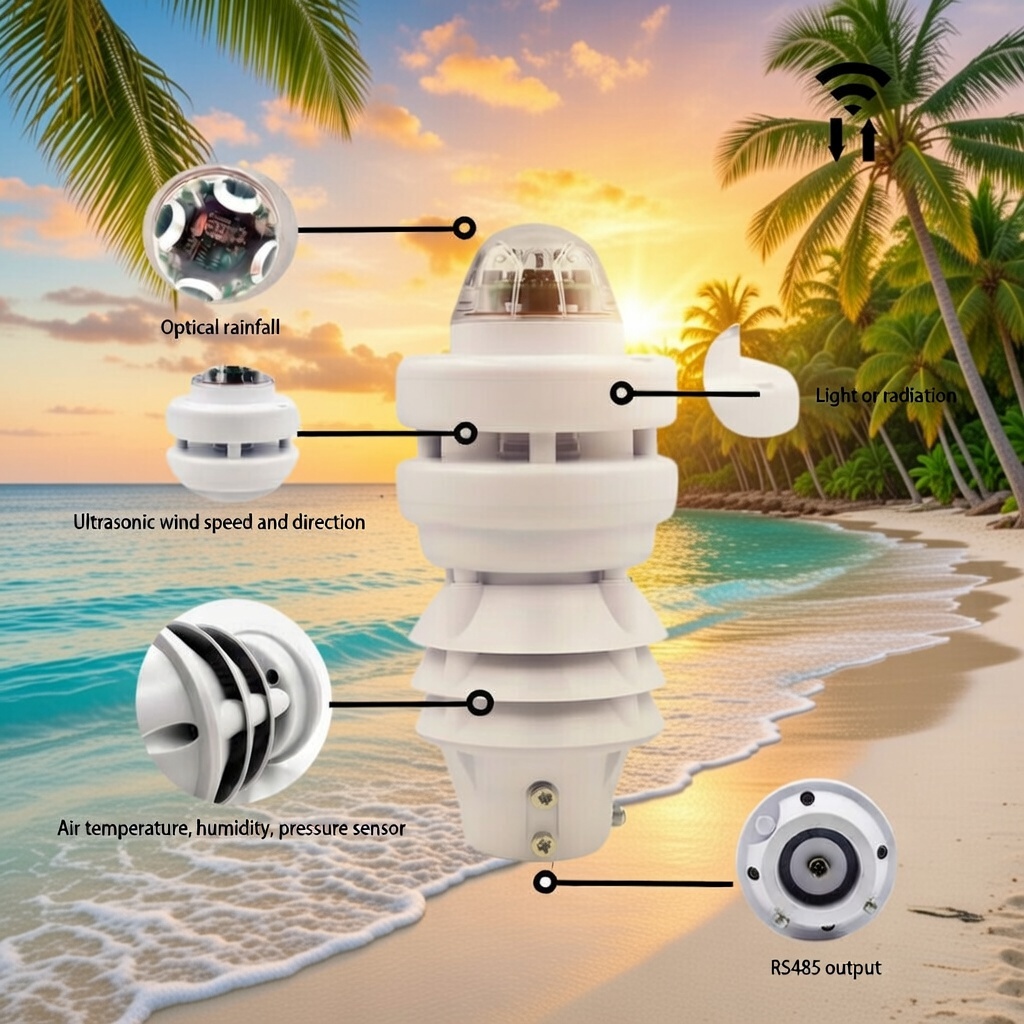
Modern ultrasonic weather stations are often designed as all-in-one solutions, integrating multiple environmental sensors into a single compact device. In addition to wind speed and direction, they can measure:
Temperature
Humidity
Atmospheric pressure
Solar radiation
Rainfall (in some models)
This integration offers several advantages:
Simplified installation
Reduced wiring and infrastructure
Lower overall system cost
For environmental monitoring projects, having all key parameters in one device improves data consistency and makes system management more efficient. It also enables seamless integration with IoT platforms and cloud-based monitoring systems.
Many environmental monitoring stations are deployed in remote areas where access to power is limited. Ultrasonic weather stations are designed with energy efficiency in mind, making them suitable for solar-powered systems.
Key benefits include:
Low power consumption
Compatibility with solar panels and battery systems
Reliable operation in off-grid locations
This makes ultrasonic weather stations ideal for applications such as:
Forest and wildlife monitoring
Remote agricultural fields
Mountain and coastal observation points
Combined with wireless communication technologies (such as RS485, Modbus, or IoT platforms), these stations can transmit data in real time without the need for constant human intervention.
While the initial investment in an ultrasonic weather station may be higher than traditional systems, the long-term cost benefits are substantial. When evaluating total cost of ownership, ultrasonic technology proves to be more economical due to:
Minimal maintenance requirements
Reduced need for spare parts
Longer service life
Lower downtime and repair costs
Additionally, the accuracy and reliability of the data can lead to better decision-making, which can result in cost savings across various applications, such as optimized irrigation, improved energy efficiency, and enhanced safety measures.
The advantages of ultrasonic weather stations make them suitable for a wide range of environmental monitoring applications, including:
Accurate wind data helps analyze pollutant dispersion and assess environmental impact.
Farmers can optimize irrigation, spraying, and crop protection based on real-time weather conditions.
Wind and solar power systems rely on precise weather data to maximize efficiency and performance.
Urban planners use weather data to improve traffic management, pollution control, and public safety.
Early warning systems for storms, floods, and wildfires depend on reliable meteorological data.
As environmental challenges continue to grow, the demand for accurate, reliable, and low-maintenance weather monitoring solutions is higher than ever. Ultrasonic weather stations offer a modern, efficient alternative to traditional systems, delivering superior performance across a wide range of applications.
From high measurement accuracy and real-time data to durability and cost efficiency, the benefits of ultrasonic technology make it an ideal choice for environmental monitoring projects. Whether deployed in smart agriculture, renewable energy, or urban infrastructure, ultrasonic weather stations provide the data needed to make informed decisions and protect both people and the environment.
Investing in an ultrasonic weather station is not just a technological upgrade—it is a strategic move toward smarter, more sustainable environmental management.
What are the uses of a rain gauge? Learn how rai
Learn how PAR sensors measure PPFD, optimize gro
Learn how soil EC sensors help optimize fertiliz
Contact: Molly
Phone: +86-17775769236
Tel: 86-0731-85117089
Email: molly@codasensor.com
Add: Building S5, Aux Square, Yuelu District, Changsha City, Hunan Province, China
We chat






 English


