Introduction
In today’s rapidly growing renewable energy and environmental monitoring industries, accurate solar radiation measurement has become essential. Whether you are building a photovoltaic (PV) power plant, deploying a professional weather station, or optimizing agricultural production, the performance of your system heavily depends on one critical component — the solar radiation sensor.
However, selecting the right sensor is not always straightforward. Different technologies, accuracy levels, output signals, and application requirements can significantly influence your final choice. A poorly selected sensor may lead to inaccurate data, reduced system efficiency, and poor decision-making.
This article will guide you step by step through the key factors you should consider when choosing a solar radiation sensor for your project, including how it integrates into a modern weather station system.
A solar radiation sensor measures the amount of solar energy received on a specific surface area over time. The measurement is usually expressed in watts per square meter (W/m²), which indicates the intensity of sunlight.
This data is critical for understanding how much solar energy is available in a specific location and how it changes throughout the day or across seasons.
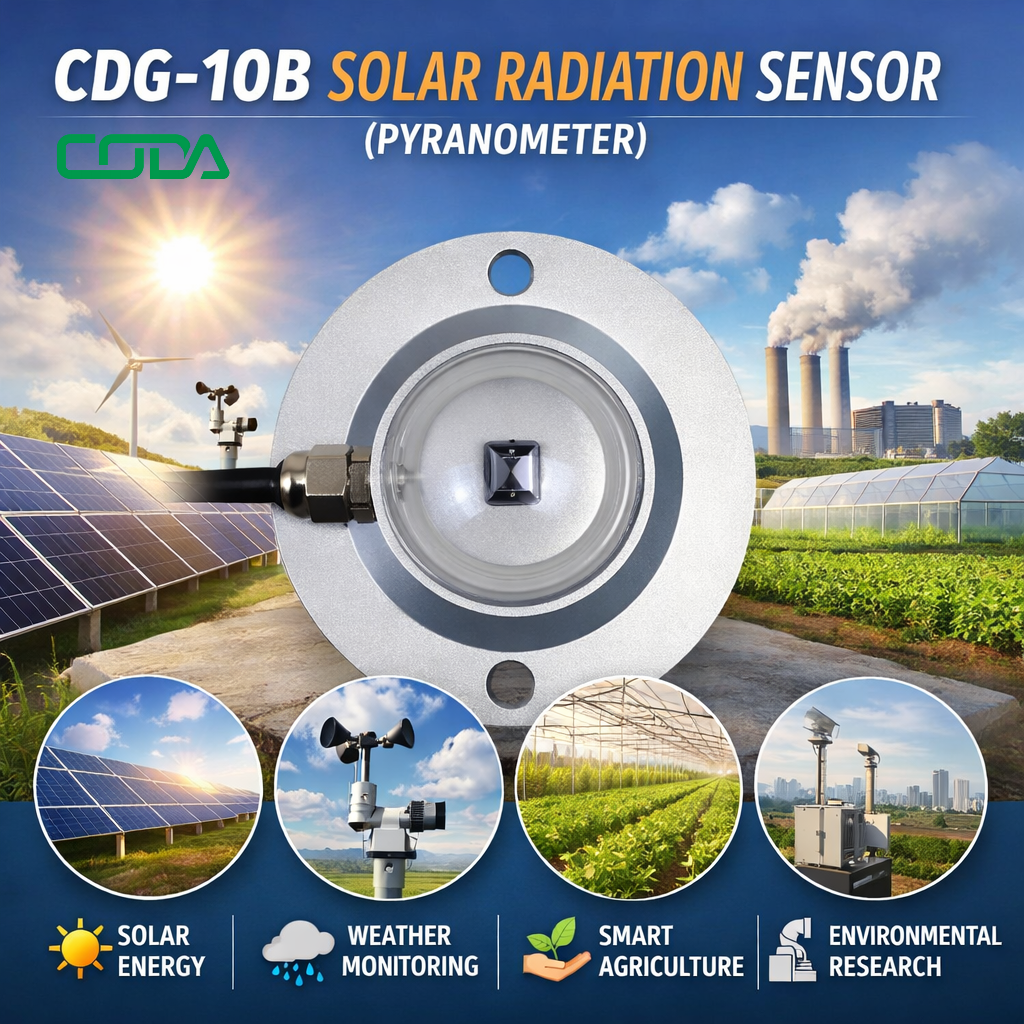
In practical applications, solar radiation sensors are widely used in:
Solar power generation systems
Smart agriculture and irrigation systems
Environmental and climate research
When combined with other meteorological sensors, solar radiation data helps build a complete picture of environmental conditions.
The first and most important step in choosing a solar radiation sensor is understanding your application.
Different projects have very different requirements:
For solar photovoltaic systems, the main goal is to evaluate energy production efficiency and monitor system performance. In this case, consistent and reliable measurements are more important than extreme scientific precision.
For weather stations, the sensor must provide stable long-term data that integrates with other environmental parameters such as temperature, humidity, wind speed, and rainfall.
For agricultural applications, solar radiation data is often used to support irrigation planning, greenhouse control, and crop growth analysis. Cost-effective solutions are usually preferred, as long as the data is stable and reliable.
For scientific research or meteorological stations, high accuracy and compliance with international standards are essential. Data quality must be precise, traceable, and consistent over long periods.
Clearly defining your use case will immediately narrow down your sensor options.
Solar radiation sensors generally fall into two main categories: thermopile sensors and silicon-based sensors.
Thermopile sensors, often used in professional pyranometers, measure a broad spectrum of solar radiation. They are known for their high accuracy and stability, making them ideal for scientific research and professional weather stations. However, they are usually more expensive and respond slightly slower to changes in sunlight.
Silicon-based sensors are more affordable and have faster response times. They are commonly used in solar PV monitoring systems where real-time performance tracking is more important than absolute measurement precision. However, they only measure a limited portion of the solar spectrum, which can lead to slight deviations in total radiation readings.
Choosing between these two types depends on whether your priority is accuracy or cost efficiency.
Accuracy is one of the most critical factors when selecting a solar radiation sensor.
High-precision sensors are essential for applications where financial or scientific decisions depend on the data. For example, in solar power plants, even small measurement errors can affect performance ratio calculations and long-term investment returns.
Lower-accuracy sensors, on the other hand, are acceptable for general monitoring purposes such as agriculture or basic environmental tracking.
It is important to match the sensor’s accuracy level with the importance of your application. Over-specifying can increase cost unnecessarily, while under-specifying can reduce data reliability.
Since solar radiation sensors are installed outdoors, they must operate reliably under harsh environmental conditions.
A high-quality sensor should withstand long-term exposure to sunlight, rain, dust, humidity, and temperature fluctuations. In coastal or desert environments, corrosion resistance becomes especially important.
A well-designed sensor should also maintain stable performance over time without significant degradation. Protective housing, UV-resistant materials, and waterproof sealing all contribute to long-term reliability.
Environmental durability is often overlooked, but it directly impacts sensor lifespan and maintenance costs.
Modern solar radiation sensors come with different output options, including analog signals and digital communication protocols.
Common interfaces include RS485, Modbus, SDI-12, 0–5V, and 4–20mA outputs. The choice depends on how the sensor will be integrated into your system.
If you are building or upgrading a weather station, digital communication protocols are usually preferred because they allow easier integration with data loggers, cloud platforms, and remote monitoring systems.
Compatibility is crucial. A high-performance sensor is useless if it cannot properly connect to your data acquisition system.
Solar radiation sensors are a key component of modern weather stations.
A complete weather station typically includes multiple sensors such as temperature, humidity, barometric pressure, wind speed, wind direction, rainfall, and solar radiation sensors.
When integrated together, these sensors provide a comprehensive view of local environmental conditions. This data can be used for climate analysis, agricultural decision-making, solar energy forecasting, and environmental monitoring.
In smart weather station systems, solar radiation data is often combined with cloud-based platforms for real-time visualization and historical analysis. This allows users to remotely monitor conditions and make data-driven decisions.
The better the integration between sensors, the more powerful the overall system becomes.
Response time refers to how quickly a sensor reacts to changes in solar intensity.
Fast response sensors are useful in dynamic environments where sunlight conditions change rapidly, such as partially cloudy regions. However, extremely fast response is not always necessary for long-term climate monitoring.
Stability is equally important. A good solar radiation sensor should provide consistent readings over long periods without drifting significantly. This ensures that long-term datasets remain reliable and comparable.
In most professional applications, a balance between response time and stability is ideal.
Even the best solar radiation sensors require periodic calibration to maintain accuracy.
Over time, exposure to environmental conditions can affect sensor performance. Regular calibration ensures that measurements remain aligned with reference standards.
In addition, routine maintenance such as cleaning the sensor surface is important. Dust, dirt, and water droplets can affect measurement accuracy if not properly managed.
For professional installations such as weather stations and solar farms, a structured maintenance plan is essential to ensure long-term reliability.
Budget is always an important consideration when selecting a solar radiation sensor.
However, the cheapest option is not always the best choice. Instead, the goal should be to find the right balance between cost, accuracy, and durability.
For large-scale solar projects, investing in higher-quality sensors can significantly improve long-term data reliability and system performance.
For smaller projects or agricultural use, cost-effective sensors may be sufficient as long as they provide stable and usable data.
Understanding your priorities will help you make the most efficient investment.
Choosing the right solar radiation sensor is a critical decision that directly affects the performance of your solar energy system, weather station, or environmental monitoring project.
To make the best choice, you should clearly define your application, understand sensor technologies, evaluate accuracy requirements, and ensure proper system integration.
A well-selected solar radiation sensor not only improves data quality but also enhances the overall efficiency and reliability of your entire monitoring system.
As weather stations and renewable energy systems continue to evolve, high-quality solar radiation measurement will remain a key foundation for smarter, data-driven decision-making.
What are the uses of a rain gauge? Learn how rai
Learn how PAR sensors measure PPFD, optimize gro
Learn how soil EC sensors help optimize fertiliz
Contact: Molly
Phone: +86-17775769236
Tel: 86-0731-85117089
Email: molly@codasensor.com
Add: Building S5, Aux Square, Yuelu District, Changsha City, Hunan Province, China
We chat






 English


