Water is one of the most critical resources in agriculture, yet it is often mismanaged. Farmers frequently rely on experience or visual observation to determine when and how much to irrigate. This approach can lead to overwatering, nutrient leaching, or water stress—all of which negatively impact crop yield and quality.
With the rise of smart agriculture, data-driven farming practices are becoming the new standard. Among the most important tools enabling this transformation is the wireless soil moisture sensor.
By providing real-time insights into soil conditions and transmitting data remotely, wireless soil moisture sensors allow farmers to make precise irrigation decisions, reduce resource waste, and improve overall productivity.
A wireless soil moisture sensor is a device designed to measure the amount of water present in the soil and transmit that data through wireless communication technologies such as LoRa, NB-IoT, or other IoT protocols.
Unlike traditional wired sensors, these devices do not require physical connections between the sensor and the monitoring system. This makes them ideal for large farms, remote areas, and modern agricultural operations that rely on cloud-based monitoring systems.
The ability to access soil data remotely—via smartphones, tablets, or computers—enables continuous monitoring without the need for manual field inspections.
Wireless soil moisture sensors operate by measuring the dielectric properties of soil, which vary depending on the water content. Since water has a much higher dielectric constant than dry soil, the sensor can accurately determine moisture levels based on this difference.
Soil Detection
The probe is inserted into the soil, where it continuously measures moisture levels in real time.
Signal Conversion
The sensor converts the detected signal into electrical data representing volumetric water content.
Wireless Transmission
The data is transmitted via a wireless module to a gateway or directly to a cloud platform.
Data Visualization
Users can view and analyze the data through software dashboards, mobile apps, or web interfaces.
This automated process ensures accurate and continuous monitoring with minimal human intervention.
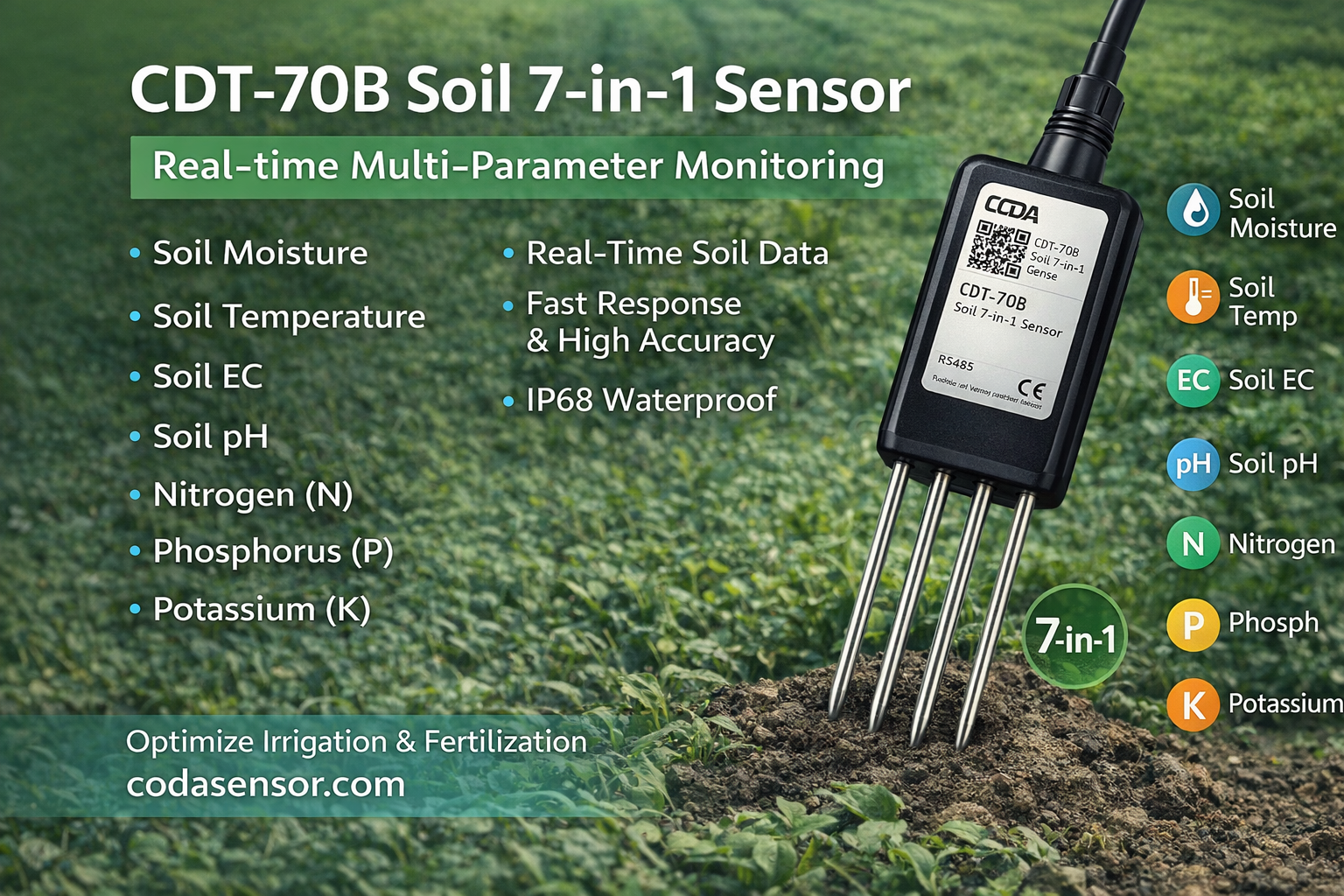
Understanding the different types of soil moisture sensors can help users choose the most suitable solution for their application.
These sensors measure the dielectric constant of the soil and are widely used due to their reliability and durability. They are less affected by soil salinity compared to other types.
Resistive sensors measure electrical resistance between two probes. While they are more affordable, they are generally less accurate and more prone to corrosion over time.
TDR sensors provide highly accurate readings by measuring the time it takes for an electromagnetic signal to travel through the soil. They are commonly used in research and high-precision applications.
FDR sensors measure soil moisture by analyzing frequency changes in the soil. They offer a good balance between accuracy and cost, making them popular in agricultural applications.
Wireless sensors provide continuous, real-time data, allowing farmers to respond quickly to changing soil conditions.
Data can be accessed from anywhere, enabling remote farm management and reducing the need for on-site inspections.
Modern sensors are designed to deliver reliable performance even in challenging soil environments, including high salinity or varying temperatures.
Many wireless sensors are optimized for long-term use with minimal power requirements, often operating on batteries for extended periods.
Without the need for complex wiring, installation is quick and flexible, making it suitable for both small and large-scale deployments.
Wireless soil moisture sensors can be integrated into IoT ecosystems, enabling advanced data analytics, automation, and smart irrigation control.
By monitoring actual soil moisture levels, farmers can irrigate precisely when needed, avoiding both overwatering and underwatering.
Efficient irrigation reduces water consumption, which is especially important in regions facing water scarcity.
Maintaining optimal soil moisture levels promotes healthier plant growth and higher productivity.
Automation minimizes the need for manual soil checks, saving time and labor.
Proper irrigation prevents nutrient leaching, ensuring fertilizers remain effective in the root zone.
Historical data and trends allow farmers to refine their irrigation strategies and improve long-term outcomes.
Wireless soil moisture sensors are widely used across various agricultural and environmental scenarios:
Farmers use sensors to optimize irrigation schedules and maximize resource efficiency.
Controlled environments benefit from precise monitoring to maintain ideal growing conditions.
Consistent soil moisture is essential for fruit quality and yield. Sensors help maintain optimal conditions.
Parks, golf courses, and sports fields use sensors to maintain healthy vegetation while minimizing water use.
Researchers and environmental agencies use soil moisture data to study ecosystems and climate patterns.
Wireless soil moisture sensors rely on different communication technologies depending on the application:
LoRa / LoRaWAN – Ideal for long-range, low-power applications
NB-IoT – Suitable for wide-area coverage with stable connectivity
Bluetooth / Wi-Fi – Used for short-range or localized monitoring
Each technology offers unique advantages in terms of range, power consumption, and data transmission frequency.
Applying too much water can lead to root rot and nutrient loss. Sensors help prevent this by providing accurate moisture data.
Insufficient watering stresses plants and reduces yield. Real-time monitoring ensures crops receive adequate water.
Traditional irrigation systems often operate on fixed schedules, ignoring actual soil conditions. Wireless sensors enable dynamic, data-driven irrigation.
Large fields may have varying soil conditions. Sensors placed in different zones help ensure uniform irrigation.
When selecting a sensor, consider the following factors:
Different soils (sand, clay, loam) have varying properties that can affect sensor performance.
Choose sensors that match the root depth of your crops.
Ensure the wireless technology meets the coverage requirements of your farm.
Battery life is critical for long-term deployments.
Check whether the sensor can integrate with your existing monitoring or irrigation systems.
Higher accuracy may be necessary for research or high-value crops.
As agriculture continues to evolve, wireless soil moisture sensors will play an increasingly important role in sustainable farming.
With advancements in IoT, artificial intelligence, and data analytics, future systems will not only monitor soil conditions but also automatically adjust irrigation in real time.
This level of automation will help farmers:
Reduce operational costs
Increase efficiency
Improve sustainability
Adapt to climate change challenges
Wireless soil moisture sensors are revolutionizing agriculture by enabling precise, efficient, and data-driven irrigation management.
By providing real-time insights into soil conditions and integrating seamlessly with modern IoT systems, these sensors help farmers optimize water usage, improve crop yield, and reduce environmental impact.
As the demand for sustainable farming practices grows, adopting wireless monitoring technologies is no longer optional—it is essential for long-term success.
1. What is the main advantage of a wireless soil moisture sensor?
The main advantage is remote monitoring without the need for wiring, allowing flexible deployment and real-time data access.
2. How deep should a soil moisture sensor be installed?
It depends on the crop type, but typically sensors are placed within the root zone to accurately reflect plant water availability.
3. Are wireless soil moisture sensors suitable for large farms?
Yes, especially those using long-range communication technologies like LoRa, which can cover large areas efficiently.
4. How long do wireless soil moisture sensors last?
With proper maintenance, high-quality sensors can last several years. Battery life depends on usage and transmission frequency.
5. Can soil moisture sensors automate irrigation systems?
Yes, when integrated with smart irrigation systems, they can automatically trigger watering based on real-time soil conditions.
What are the uses of a rain gauge? Learn how rai
Learn how PAR sensors measure PPFD, optimize gro
Learn how soil EC sensors help optimize fertiliz
Contact: Molly
Phone: +86-17775769236
Tel: 86-0731-85117089
Email: molly@codasensor.com
Add: Building S5, Aux Square, Yuelu District, Changsha City, Hunan Province, China
We chat






 English


