Smart Cities & IoT: The Role of Ultrasonic Weather Stations in Urban Planning
As the global population shifts toward urban centers, cities face an unprecedented convergence of challenges: intensifying heat waves, erratic precipitation, and deteriorating air quality. The "Smart City" concept has evolved from a buzzword into a survival strategy, relying on data to manage resources and ensure livability. At the heart of this data revolution lies the smart city weather network.
While traditional meteorology relies on sparse, airport-based observation points, the modern resilient city requires hyper-granular data. This article explores the critical role of ultrasonic weather station urban planning, detailing how these advanced, maintenance-free sensors are becoming the nervous system of sustainable urban infrastructure.
Beyond Mechanical Sensor: The Ultrasonic Advantage
For decades, measuring wind speed and direction meant using cup anemometers and wind vanes. While effective in open fields, these mechanical devices are ill-suited for the "urban canyon." They are prone to mechanical failure caused by grit, ice, and bird nesting, and they struggle with the turbulent, multi-directional airflows typical of city streets.
IoT environmental sensors utilizing ultrasonic technology represent a paradigm shift.
How It Works: Ultrasonic sensors use acoustic resonance technology. They send ultrasonic sound pulses between transducers; the time it takes for the sound to travel is affected by the speed and direction of the wind. By calculating the time difference (flight of time), the onboard processor calculates precise wind speed and direction.
Zero Moving Parts: There are no bearings to wear out or cups to freeze. This results in low-maintenance urban sensors that can be deployed on thousands of lampposts without requiring a maintenance crew.
High Sensitivity: They can detect low-speed airflow that mechanical sensors might miss, which is crucial for understanding stagnation in street canyons.
Compact Footprint: These stations often integrate precipitation, temperature, humidity, and pressure sensors into a single, unobtrusive unit—perfect for aesthetic integration into city streetscapes.
Core Application 1: Mitigating the Urban Heat Island (UHI) Effect
One of the most pressing applications for this technology is urban heat island monitoring. Concrete, asphalt, and glass absorb heat during the day and release it at night, causing cities to be significantly warmer than surrounding rural areas. However, this heat is not distributed evenly.
By deploying a grid of ultrasonic weather stations, planners can move beyond generic city-wide averages to real-time microclimate monitoring.
Mapping the Hotspots: A dense sensor network reveals specific intersections, neighborhoods, or even individual streets that suffer from heat retention.
Targeting Interventions: Planners can identify vulnerable populations living in high-heat zones without adequate cooling and prioritize planting tree canopies or installing cool pavements exactly where they are needed most.
Measuring Impact: The data allows cities to measure the "before and after" impact of green infrastructure projects to validate public investment.
Core Application 2: Pollution & Air Quality Management
Air quality monitors measure what is in the air, but they don't tell you where it is going. To truly manage urban health, pollution dispersion modeling tools require precise wind data.
Ultrasonic weather stations act as the dynamic layer in air quality management. In complex urban environments, wind tunnels created by skyscrapers can trap pollutants at street level. By correlating wind speed and direction data with particulate matter (PM2.5/PM10) readings, cities can:
Trace Sources: Triangulate the origin of sudden pollution spikes (e.g., a specific construction site or industrial vent).
Dynamic Traffic Management: Reroute traffic away from "canyon" streets when ventilation is poor to prevent smog buildup.
Industrial Zoning: Inform zoning decisions by analyzing prevailing wind patterns to ensure industrial emissions blow away from residential zones.
Core Application 3: Public Safety and Infrastructure Resilience
Climate resilience is about responsiveness. Public safety weather warnings rely on the speed and accuracy of data. Ultrasonic stations, integrated into an IoT network, provide the hyperlocal weather data for cities necessary to protect citizens and assets.
Wind Monitoring for Infrastructure: High-rise construction cranes, suspension bridges, and temporary event stages are vulnerable to wind gusts. Real-time ultrasonic monitoring triggers automated safety alerts when wind loads exceed safe thresholds.
Flash Flood Prediction: Urban flooding is often caused by intense, localized cloudbursts that overwhelm drainage in specific sectors. Optical rain sensors (often integrated into ultrasonic stations) provide instant precipitation data, allowing automated stormwater systems to open valves or divert flow before flooding occurs.
Emergency Response: During chemical spills or fires, knowing the precise, street-level wind direction allows first responders to evacuate the correct city blocks, potentially saving lives.
Core Application 4: Data-Driven Urban Planning & Design
The role of ultrasonic weather station urban planning extends far beyond day-to-day operations; it is fundamental to the design of the future city.
Urban Ventilation Monitoring: "City breathability" is a growing focus in urban design. Planners use ultrasonic data to understand how wind moves through the city. This informs the orientation of new high-rises to allow fresh air corridors to penetrate the city center, flushing out heat and pollutants.
Pedestrian Comfort Studies: By collecting long-term wind data, architects can design podiums and windbreaks that ensure pedestrian comfort, revitalizing public squares and outdoor retail spaces.
Energy Efficiency: Building Management Systems (BMS) can tap into the local weather network. If sensors detect high solar radiation and rising ambient temperature, smart buildings can pre-cool atriums or lower automatic blinds, reducing peak energy demand across the grid.
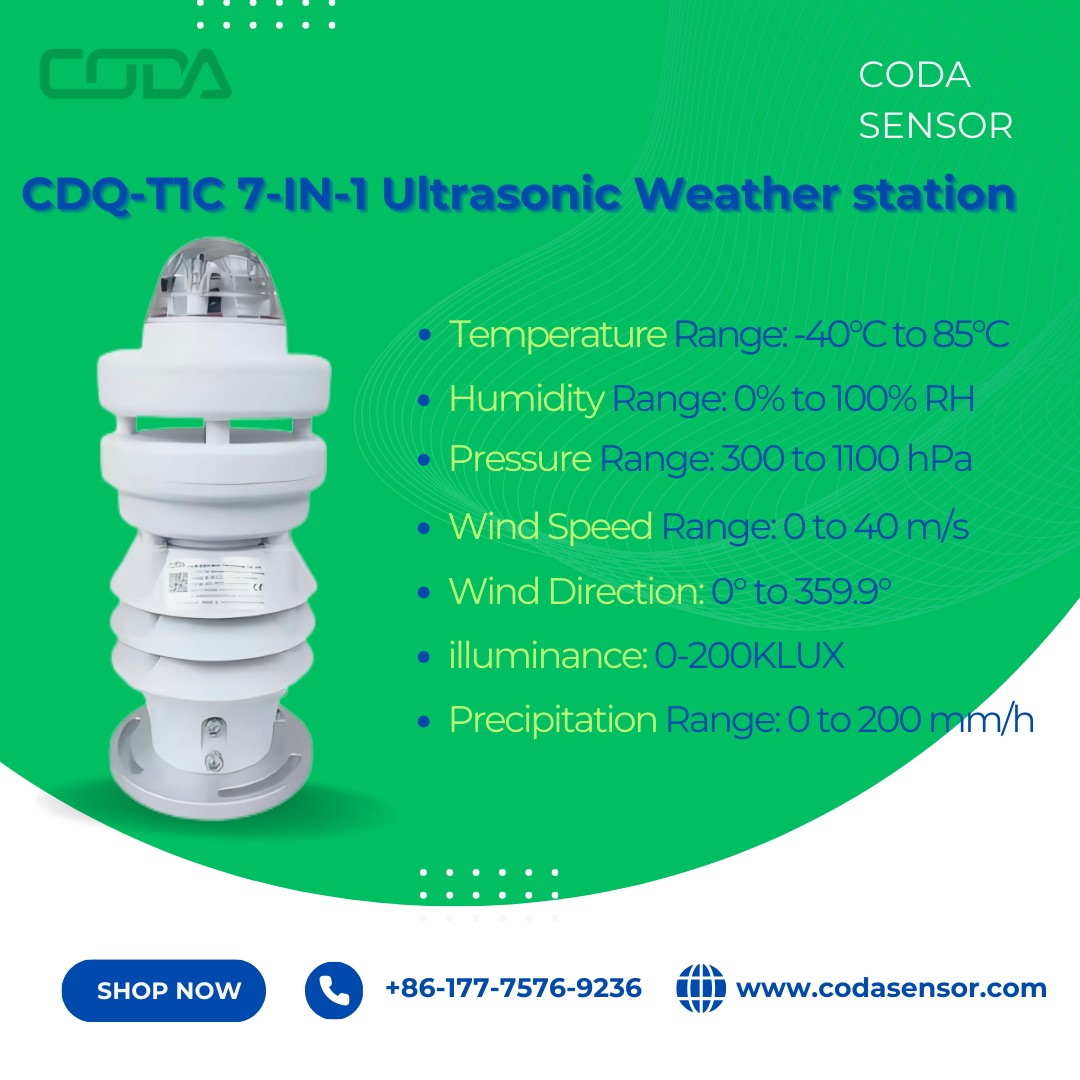
Integration: The IoT Framework
The power of ultrasonic weather stations lies in their connectivity. These are not standalone devices; they are nodes in a massive IoT environmental sensor ecosystem.
Through protocols like LoRaWAN, NB-IoT, or 5G, these stations transmit data to a centralized City Operations Center.
GIS Integration: Data is overlaid onto Geographic Information Systems (GIS), allowing planners to view weather layers alongside traffic, utility, and zoning maps.
BIM (Building Information Modeling): Architects use historical site data to simulate environmental stresses on proposed structures.
Open Data for Citizens: Cities can push data to public apps, allowing a cyclist to choose the least polluted route to work or a parent to check the UV index at a specific park.
Case Studies in Resilience
Hypothetical Case A: The Cool Corridor ProjectCity Alpha faced rising summer mortality rates due to heat stress. By deploying a network of 200 ultrasonic stations, they identified a 4°C temperature spike in a specific concrete-dense residential district. The city utilized this real-time microclimate monitoring to justify the conversion of four traffic lanes into linear parks. Post-project data confirmed a 2.5°C reduction in ambient temperature, validating the "Cool Corridor" strategy.
Hypothetical Case B: Port City SafetyPort Beta, a logistics hub, struggled with crane accidents during sudden squalls. They installed ultrasonic wind sensors on all gantries, networked to a central port authority system. The result was a dynamic "Go/No-Go" system for operations. This public safety weather warning system reduced wind-related equipment damage by 100% in the first year.
Future Outlook and Conclusion
As we look toward the future, the integration of Artificial Intelligence (AI) with smart city weather networks will unlock predictive capabilities. AI will not just report that a storm is happening; it will predict how a storm will interact with the specific topography of a city street, automating traffic lights and drainage systems minutes before the rain hits.
For urban planners, municipal officials, and developers, the message is clear: You cannot manage what you do not measure.
Ultrasonic weather station urban planning is no longer a futuristic concept—it is a present-day necessity. By investing in durable, low-maintenance, and high-precision IoT environmental sensors, cities can transition from reactive entities to proactive, resilient organisms. This technology empowers us to build cities that are not only smarter but safer, cooler, and more breathable for generations to come.
Key Takeaways for Urban Planners
Prioritize Durability: Choose ultrasonic sensors to minimize OpEx (Operational Expenditure) associated with maintenance.
Think Network, Not Node: The value is in the density of the data. One sensor is a thermometer; a network is a map.
Data Silos are Fatal: Ensure your weather data integrates with traffic, energy, and health departments for true smart city functionality.
What are the uses of a rain gauge? Learn how rai
Learn how PAR sensors measure PPFD, optimize gro
Learn how soil EC sensors help optimize fertiliz
Contact: Molly
Phone: +86-17775769236
Tel: 86-0731-85117089
Email: molly@codasensor.com
Add: Building S5, Aux Square, Yuelu District, Changsha City, Hunan Province, China
We chat






 English


