In today’s environment of climate volatility, regulatory pressure, and efficiency-driven operations, simple weather snapshots no longer meet professional requirements. Knowing that it rained is insufficient; decision-makers must understand how much, how fast, from which direction, and how the soil responded.
This demand has accelerated adoption of the automatic weather monitoring system—not as a collection of standalone sensor, but as a fully integrated measurement ecosystem. At the center of this ecosystem sits the environmental data logger, the component responsible for turning scattered signals into structured, time-aligned intelligence.
This article explains how data loggers unlock the full technical and commercial value of multi-parameter weather stations by integrating sensors, synchronizing measurements, and enabling advanced analytics.
In a professional weather station data acquisition system, each sensor functions as a specialized measurement node. Understanding their principles clarifies why data logging quality is critical.
Wind is highly variable in both magnitude and direction, making accurate measurement technically demanding.
Typical Technologies
Cup anemometers: Convert rotational speed into pulse signals proportional to wind speed.
Ultrasonic anemometers: Measure sound-wave transit time differences to calculate wind speed and direction with no moving parts.
Why Wind Data Matters
Structural safety (tower cranes, bridges, high-rise buildings)
Wind resource assessment for renewable energy
Spray drift control in precision agriculture
Evapotranspiration (ET) modeling
Reliable wind speed data acquisition depends on high-resolution sampling and precise timestamping by the data logger.
Atmospheric data alone cannot explain plant response, slope stability, or water balance. Soil moisture sensor data logging fills this gap.
Measurement Principles
TDR (Time Domain Reflectometry): Measures signal travel time through soil
FDR/Capacitance: Measures changes in dielectric permittivity
Many professional probes also measure:
Soil temperature
Electrical Conductivity (EC)
Salinity indicators
Why Soil Data Matters
Root-zone–based irrigation scheduling
Drought stress detection
Landslide and slope stability monitoring
Water-use optimization in smart agriculture
Most rainfall measurement logger systems use tipping-bucket rain gauges.
Operating Principle
A calibrated bucket tips after collecting a defined rainfall volume, generating a pulse signal. The data logger converts pulse frequency into:
Rainfall total
Rainfall intensity
Why Rainfall Intensity Matters
Flood early-warning systems
Urban drainage and stormwater design
Reservoir inflow estimation
Soil infiltration analysis
Solar radiation drives both biological growth and renewable energy production.
Common Sensor Types
Thermopile pyranometers: High accuracy, broad spectral response
Silicon photodiode sensors: Faster response, lower cost
Key Applications
Solar plant performance verification
Crop growth and photosynthesis analysis
Evapotranspiration modeling
Climate and microclimate research
A reliable solar radiation monitoring system depends on stable signal conversion and temperature compensation—functions handled by the data logger.
If sensors are the sensory organs, the environmental data logger is the system’s brain. It coordinates power, timing, signal conversion, and storage in harsh outdoor environments.
In remote installations, power efficiency is critical. The data logger:
Powers sensors only during measurement cycles
Synchronizes readings across all channels
Ensures temporal alignment of multi-parameter data
This synchronization allows accurate cross-variable correlation, such as matching wind gusts with rainfall intensity at the same second.
Environmental sensors output diverse signal types:
Millivolt-level analog signals
Pulse signals
Digital protocols (SDI-12, RS-485)
The data logger performs Analog-to-Digital (A/D) conversion, translating raw electrical inputs into engineering units such as:
m/s (wind speed)
mm (rainfall)
W/m² (solar radiation)
Every data point is assigned a precise timestamp and stored in non-volatile memory. This ensures:
Continuous time-series datasets
Data recovery after power interruptions
Long-term compliance with research and regulatory requirements
The true strength of an automatic weather station lies in its integration architecture.
Modern data loggers support multiple input types:
Pulse counters: Rain gauges, cup anemometers
Analog inputs: Pyranometers, temperature sensors
Digital buses: SDI-12 and RS-485 smart sensors
This unified interface enables correlated data analysis across environmental domains.
| Industry | Sensor Combination | Actionable Insight |
|---|---|---|
| Precision Agriculture | Soil Moisture + Rainfall + Solar Radiation | Accurate evapotranspiration and irrigation automation |
| Environmental Monitoring | Wind Direction + Air Quality | Pollution source identification |
| Renewable Energy | Solar Radiation + Temperature + Wind | Power plant performance ratio analysis |
| Hydrology | Rainfall Intensity + Soil Moisture | Flash flood risk assessment |
Advanced data loggers can calculate derived parameters in real time, including:
Vapor Pressure Deficit (VPD)
Dew point temperature
Heat stress and wind chill indices
These computed values enable intelligent alarms, control outputs, and automated responses without relying solely on cloud processing.
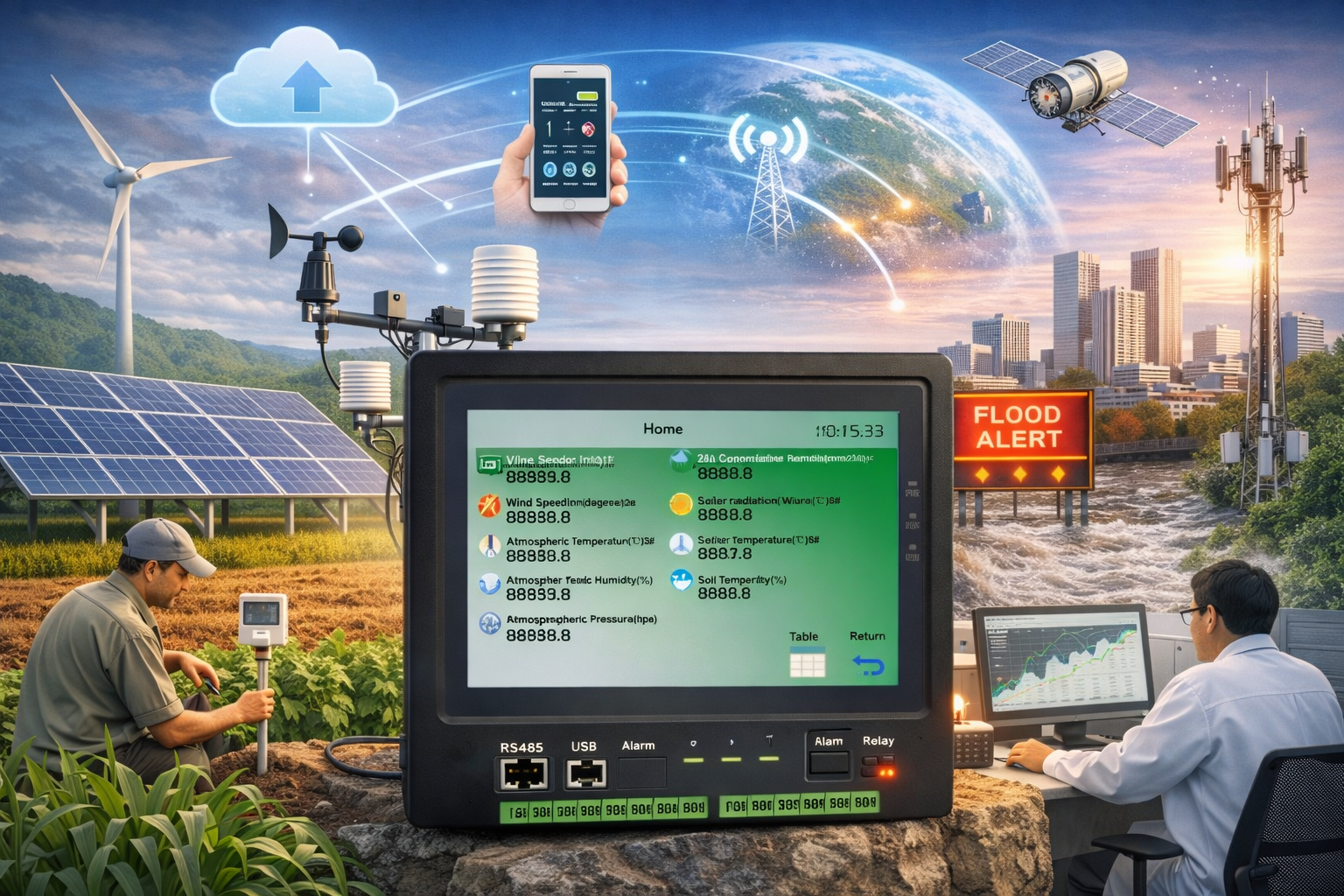
Modern automatic weather monitoring systems have evolved beyond isolated instruments. The environmental data logger is now the central intelligence hub—powering sensors, synchronizing measurements, and transforming raw signals into actionable insights.
As IoT connectivity and cloud analytics continue to advance, the importance of local data integrity remains unchanged. Accurate sensors and a robust data logger form the foundation upon which predictive models, AI analytics, and smart decision-making are built.
Discussion Prompt
For agricultural and environmental professionals: In your region, which variable drives better irrigation decisions—continuous soil moisture monitoring or real-time solar radiation data—and why?
What are the uses of a rain gauge? Learn how rai
Learn how PAR sensors measure PPFD, optimize gro
Learn how soil EC sensors help optimize fertiliz
Contact: Molly
Phone: +86-17775769236
Tel: 86-0731-85117089
Email: molly@codasensor.com
Add: Building S5, Aux Square, Yuelu District, Changsha City, Hunan Province, China
We chat






 English


