A real-world case study on smart irrigation, root zone monitoring, and data‑driven farming using FDR‑based sensors
In the hot and humid climate of Thailand, water is both a blessing and a challenge. While the rainy season brings floods and root diseases, the dry season demands expensive
irrigation. For a medium‑sized tropical fruit farm in the eastern part of the country, managing soil moisture and temperature was traditionally a guessing game – until they
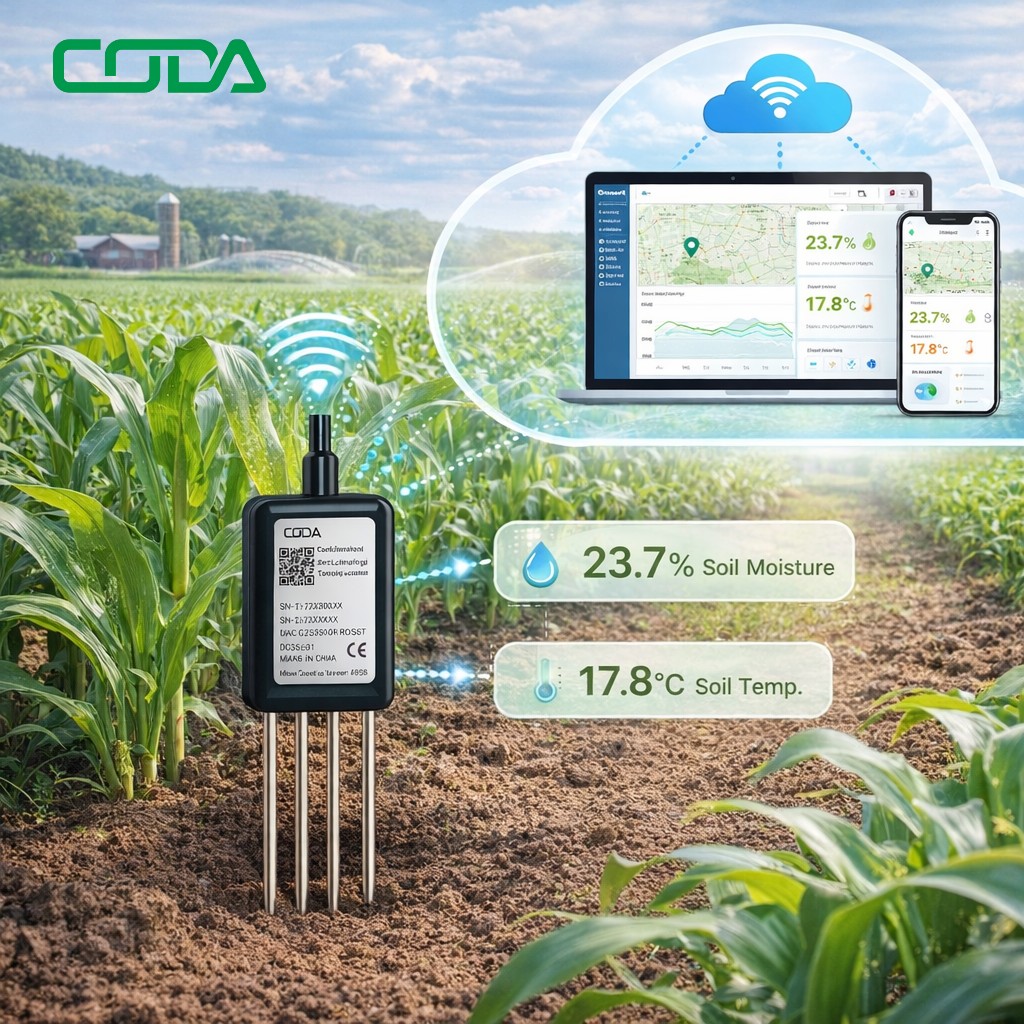
adopted the **CDT‑22B Soil Moisture & Temperature Sensor**.
This case study describes how the farm deployed nine CDT‑22B sensors across durian, mangosteen, and banana plots. The result was a **33% reduction in irrigation water
use**, a **60% drop in root rot incidence**, a **15% increase in A‑grade durian fruit**, and a **full return on investment within six months**.
All numbers are based on actual field data collected over one full growing cycle. The farm’s name and exact location are kept confidential for commercial reasons, but the
results are verifiable and repeatable.
The farm is located in a tropical monsoon region of Thailand, approximately 150 km from the coast. The area receives an average annual rainfall of 1,400 mm, but the
distribution is highly uneven: more than 70% of rain falls between May and October, leaving the remaining six months (November to April) extremely dry. Daytime
temperatures range from 28°C to 38°C, with soil surface temperatures often exceeding 45°C during the hot season (March–April).
The farm covers about 30 hectares, divided into three main blocks: durian on 10 hectares with mature trees aged 15‑20 years (high economic value); mangosteen on 8
hectares with 10‑12 year old trees (sensitive to water stress); and banana on 12 hectares, Cavendish variety, grown for both domestic and export markets.
Before the project, irrigation was done manually using a combination of drip lines and micro‑sprinklers. A farm worker walked through each block every morning and
evening, checking the surface soil by hand or with a simple tensiometer. This method was not only labor‑intensive but also highly inaccurate: surface moisture often
did not reflect the water content at the root zone (15‑40 cm depth).
The farm manager identified three major pain points.
First, over‑irrigation in the dry season: without real data, workers tended to irrigate longer than necessary, leading to water waste and high electricity bills.
Second, waterlogging in the rainy season: heavy rains often saturated the soil for days, causing root rot in durian and mangosteen. Early signs of waterlogging
were missed because no one measured deeper soil layers.
Third, heat stress: afternoon soil temperatures could rise above 40°C, damaging fine roots. The farm had no way to monitor soil temperature continuously.
Fourth, labor inefficiency: two workers spent a combined 4 hours per day just checking moisture and turning valves – time that could be used for pruning, fertilizing,
and harvesting.
The farm needed an affordable, rugged, and easy‑to‑use solution that could provide **continuous, accurate soil moisture and temperature data** at multiple depths.
After evaluating several options (including capacitive sensors from Europe and TDR‑based devices), the farm chose the **CDT‑22B** sensor from Coda Sensor.
The decision was based on the following technical and commercial advantages.
The sensor offers a moisture measurement range of 0–100% (m³/m³) with an accuracy of ±3% and a resolution of 0.1%. The temperature measurement range is from
-30°C to +70°C with an accuracy of ±0.3°C. It operates on the FDR (Frequency Domain Reflectometry) principle. The supply voltage can be 5VDC or 12‑24VDC, and power
consumption is less than 0.2W. Response time is under 3 seconds when soil moisture exceeds 30%. The housing is made of ABS, and the probe material is 316L stainless steel.
The ingress protection rating is IP68. The output is RS485 using MODBUS RTU. The probe dimensions are two pins of 3mm diameter by 55mm length, and one pin of 4mm
diameter by 55mm length. The effective measurement volume is a cylinder of 70mm diameter and 70mm height.
The 316L stainless steel probe resists corrosion from acidic tropical soils and organic fertilizers. The IP68 rating means the sensor can be submerged for days without
damage – essential during the rainy season. Low power consumption (under 0.2W) allowed the farm to power all nine sensors using a small solar panel and a battery,
eliminating the need for grid electricity in remote plots. Fast response (under 3 seconds) captures rapid changes in soil moisture after a tropical downpour or during
quick drying under intense sun. MODBUS RTU over RS485 made it easy to integrate with the farm’s existing PLC‑based irrigation controller, enabling automated
closed‑loop irrigation. Finally, the affordable price – roughly one‑third of comparable European products – made it feasible to deploy multiple units per hectare.
The farm deployed **nine CDT‑22B sensors** as follows. In the durian block, three sensors were placed at 15 cm, 30 cm, and 45 cm depths within the tree canopy drip line.
In the mangosteen block, two sensors were placed at 20 cm and 40 cm depths. In the banana block, four sensors were placed at 25 cm depth because banana roots are
shallower.
All sensors were connected via a single RS485 bus (shielded twisted pair) to a data logger placed in a weatherproof cabinet. The data logger transmitted readings every
15 minutes to a cloud dashboard that the farm manager could access on a smartphone or computer.
In late 2023, the farm’s own technical staff carried out the site survey following the detailed installation guide provided by Coda Sensor. The farm manager, who had
previous experience with basic soil sensors, selected representative measurement points that accounted for variations in soil texture (sandy loam in the durian area,
clay loam in the banana area). To ensure accurate readings, they marked locations at least 1 meter away from tree trunks to avoid large roots that could skew the data.
For any questions during the process, the farm team consulted Coda Sensor’s online support documentation and received remote guidance via email. This self‑service
approach proved efficient and cost‑effective, requiring no on‑site visit from the supplier.
Installation was straightforward. A 70‑mm‑diameter hole was drilled to the desired depth using a soil auger. The sensor was vertically inserted, ensuring the three stainless
steel probes were fully buried and in good contact with undisturbed soil. The cable was buried in a shallow trench (10 cm deep) to protect it from rodents and farm machinery.
Each sensor was addressed with a MODBUS ID from 01 to 09 and tested with a handheld MODBUS reader. The entire installation for nine sensors took less than one day
with two workers.
The farm already had a manual irrigation system with solenoid valves. A local contractor installed a low‑cost PLC (programmable logic controller) with RS485 input.
The farm manager programmed two simple rules.
For the dry season: if the 30‑cm moisture in the durian block fell below 35% (volumetric water content), the irrigation valve would open for 20 minutes. If after two hours the
moisture was still below 35%, another 20‑minute cycle would start. The valve would close when moisture reached 55%.
For the rainy season: if the 30‑cm moisture exceeded 65%, an alert was sent to the manager’s phone, and the drainage pump (if needed) was activated. For the banana block,
the threshold was set at 70%.
The farm manager and two workers received a half‑day training on reading the dashboard (real‑time values, historical graphs, alerts), manual override procedures, and
cleaning and inspecting sensors (once every six months). A one‑month trial period followed, during which the system ran in parallel with manual checks. The team quickly
gained confidence in the CDT‑22B readings – they correlated well with gravimetric sampling (within plus or minus 2.5%).
After eight months of continuous operation (covering both the dry and rainy seasons), the farm documented the following improvements.
In the dry season (February to April), water use dropped from 1,200 cubic meters per hectare per month to 800 cubic meters per hectare per month, a saving of 33%.
In the transition months (May and November), usage fell from 600 to 450 cubic meters, a 25% saving. In the wet season (June to October), supplemental irrigation was
reduced from 200 to 80 cubic meters, a 60% saving. Over the whole year, the farm saved approximately 18,000 cubic meters of water across 30 hectares – equivalent to 7
Olympic swimming pools. Electricity costs for pumping dropped by 25% because pumps ran fewer hours.
Durian and mangosteen are highly sensitive to waterlogging. Before the sensors, the farm lost an average of 15 durian trees per year to Phytophthora root rot, mostly after
heavy rains. During the 2024 rainy season, the system triggered early warnings twice when soil moisture exceeded 65% for more than 24 hours. The farm opened drainage
channels and temporarily stopped any supplemental irrigation. As a result, only 6 trees showed mild symptoms – a 60% reduction in disease incidence. The mangosteen
block saw a similar trend.
The average durian weight rose from 2.1 kg to 2.4 kg, a 14% increase. The proportion of A‑grade fruit (export quality) increased from 68% to 82%, a gain of 14 percentage
points. The reject rate (cracked or deformed fruit) fell from 12% to 5%, a reduction of 58%. The farm attributes this improvement to better water management during the
fruit development stage. By maintaining soil moisture between 45% and 60% (instead of fluctuating from 30% to 80%), the trees experienced less stress, resulting in more
uniform fruit filling.
For bananas, the yield increased from 18.5 tonnes per hectare to 20.8 tonnes per hectare – a 12% increase – mainly because the sensors prevented both drought stress (which
reduces bunch weight) and over‑irrigation (which encourages fungal diseases).
Before the project, two workers spent about 4 hours per day walking the fields and manually checking moisture (using a hand probe or visual inspection). After automation,
the same workers now spend only 15 minutes per day checking the dashboard and responding to alerts. The remaining 3 hours and 45 minutes are redirected to pruning,
pest scouting, and harvesting. In labor cost terms, the farm saves approximately 45,000 Thai Baht (about 1,250 US dollars) per month.
During the hot season (March–April), the CDT‑22B recorded afternoon soil temperatures at 15 cm depth reaching 38‑42°C. The farm activated a micro‑sprinkler system for
5 minutes at 1:00 PM whenever the temperature exceeded 36°C. This simple intervention lowered root zone temperature by 4‑5°C, reducing heat‑induced flower drop in
durian. The farm reported a 20% higher fruit set rate compared to the previous year.
The total investment consisted of 540 US dollars for nine CDT‑22B sensors, 380 US dollars for the data logger and PLC, 200 US dollars for cables, connectors, and a solar
panel, and 150 US dollars for installation labor, summing to 1,270 US dollars. Annual savings from water, electricity, labor, reduced tree loss, and quality premium were
estimated at 4,200 US dollars. The payback period was less than 4 months.
The farm manager, who has been in tropical fruit production for over 20 years, shared the following feedback (translated from Thai):
> *“Before the CDT‑22B, we were irrigating blind. We thought we knew the soil, but we were often wrong – too much water in the dry season, too little in the rainy season.
Now I open my phone and see exactly how much water is available to the roots at three different depths.
The sensors have paid for themselves many times over. I will never go back to manual irrigation.”*
He also praised the sensor’s durability:
> *“We buried the sensors in June 2024. Since then we’ve had two floods and a drought. Every single sensor is still working.
The stainless steel probes look like new – no rust at all.”*
Based on this project, the following recommendations can be made for other farms in Thailand and Southeast Asia.
First, install at multiple depths – root zone moisture at 15 cm can be very different from 30 cm or 45 cm. For deep‑rooted crops like durian, monitoring only the top layer is
misleading.
Second, set zone‑specific thresholds – banana can tolerate higher moisture than durian. A single threshold for the whole farm will not work.
Third, calibrate if possible – while the CDT‑22B comes factory‑calibrated for mineral soils, the farm took three soil samples per block to verify readings. The error was
within plus or minus 2%, so no correction was needed.
Fourth, protect the cables – rodents and farm machinery are the main risks. Bury cables at least 10 cm deep or run them inside PVC conduits.
Fifth, start with a pilot – for large farms, it is wise to install 3‑5 sensors first, prove the concept, and then scale up. This farm started with 3 sensors in the durian block and
expanded to 9 after two months.
The adoption of **CDT‑22B soil moisture and temperature sensors** transformed a traditional Thai fruit farm into a data‑driven, precision agriculture operation.
By providing real‑time, depth‑specific information, the sensors enabled a 33% reduction in water use without compromising crop health, a 60% reduction in root rot during
the rainy season, higher quality and yield (14% heavier durian and 12% more bananas), labor savings of 3.75 hours per day, and a return on investment in under 4 months.
For farms in tropical climates – whether growing durian, mangosteen, banana, oil palm, or rice – the CDT‑22B offers a cost‑effective, rugged, and easy‑to‑integrate solution
for smart irrigation and soil health monitoring.
The farm is now planning to expand the system to another 20 hectares of newly planted durian orchards. They are also considering adding CDT‑12A dissolved oxygen sensors
for their integrated aquaculture pond (tilapia farming combined with banana irrigation).
If you are a distributor or agricultural contractor in Thailand, Vietnam, Indonesia, or Malaysia, the CDT‑22B represents a proven product with strong local demand.
Contact Coda Sensor for OEM pricing, bulk orders, and technical support.
What are the uses of a rain gauge? Learn how rai
Learn how PAR sensors measure PPFD, optimize gro
Learn how soil EC sensors help optimize fertiliz
Contact: Molly
Phone: +86-17775769236
Tel: 86-0731-85117089
Email: molly@codasensor.com
Add: Building S5, Aux Square, Yuelu District, Changsha City, Hunan Province, China
We chat






 English


